Modeling Code (Platform) Integrated Groundwater/Surface Water - - PowerPoint PPT Presentation

modeling code platform
SMART_READER_LITE
LIVE PREVIEW

Modeling Code (Platform) Integrated Groundwater/Surface Water - - PowerPoint PPT Presentation

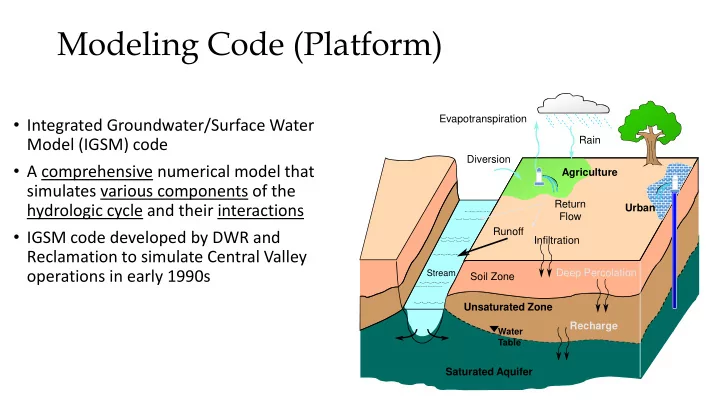
Modeling Code (Platform) Integrated Groundwater/Surface Water Evapotranspiration Rain Model (IGSM) code Diversion A comprehensive numerical model that Agriculture simulates various components of the Return hydrologic cycle and their


slide-1
SLIDE 1

Modeling Code (Platform)

  • Integrated Groundwater/Surface Water

Model (IGSM) code

  • A comprehensive numerical model that

simulates various components of the hydrologic cycle and their interactions

  • IGSM code developed by DWR and

Reclamation to simulate Central Valley

  • perations in early 1990s

Rain Evapotranspiration Diversion Saturated Aquifer Soil Zone

Stream

Agriculture Infiltration

Water Table

Deep Percolation Runoff Unsaturated Zone Recharge Return Flow Urban

slide-2
SLIDE 2

Modeling Application

  • Developed in 1993 for City and County of Sac

to support Water Forum (SacIGSM)

  • As part of the American River Water

Resources Investigation in mid-1990s, linked to the North American River Basin (NARIGSM) Model

  • Updated in SGA in 2007
  • Updated in central Sac County in 2016
  • Used by south Sacramento County for draft

Groundwater Management Plan in 2011

  • Today referred to as the Sacramento

Integrated Water Resources Model (SacIRWM)

slide-3
SLIDE 3

Recent DWR Modeling Efforts

  • DWR developed its own version of original IGSM code in the early

2000’s and has continuously updated it since

  • Now referred to as Integrated Water Flow Model (IWFM)
  • Latest Version (2015.0.475) released in 2016
  • Current Commitment to IWFM
  • The Department shall provide the California Central Valley Groundwater-

Surface Water Simulation Model (C2VSIM) and the Integrated Water Flow Model (IWFM) for use by Agencies in developing the water budget (Article

  • 5. Subarticle 2§ 354.18. Water Budget)
  • Currently updating 2 applications of IWFM expected by end of 2017
  • Central California Valley Simulation Model (C2VSim)
  • Sacramento Valley Simulation Model (SacSim)
slide-4
SLIDE 4

C2VSim

  • Has been in use for many

years by DWR and Reclamation

  • Coarse Grid (IGSM) – 1989
  • Fine Grid (IWFM) – 2011
  • 3 aquifer layers now (moving

to 4 layers)

  • Simulation Period: 1922-2009

now (moving to 2015)

  • Updated data through 2015
slide-5
SLIDE 5

SacSim

  • Primary Goal (support Groundwater Substitution

Transfers):

  • Enhance DWR's C2VSim model to ensure that it

meets essential modeling requirements for evaluating the impacts of groundwater substitution transfers on stream depletion in the Sacramento Valley

  • Secondary Goal (support SGMA):
  • Develop a tool for estimating water budgets,

simulating SW-GW interactions and land subsidence, and evaluating different SGM scenarios in the Sacramento Valley by DWR and GSAs

slide-6
SLIDE 6

Why Use IWFM?

  • Widely used in Central Valley and by

adjacent basins to North American

  • Designed for developing total water

budget consistent with SGMA requirements

  • Designed for analysis of management

scenarios

  • DWR to support GSAs on C2VSim use and

application per regulations

  • Documentation and training available

from DWR

slide-7
SLIDE 7

Possible Option for Moving Forward in Region

  • Develop a unified IWFM application for North

American, South American, and Cosumnes groundwater subbasins

  • Use relevant datasets from existing SacIRWM,

NARIGSM and Roseville models

  • Use relevant datasets from the basin-scale C2VSim

and SVSIM currently being upgraded by the DWR

  • Work directly with representatives from each

subbasin to ensure a wide acceptance of the modeling approach, assumptions, data, and results among the stakeholders

slide-8
SLIDE 8

Next Steps

  • Decide on modeling platform
  • Decide on modeling application
  • If decide to move forward :
  • Model scope, schedule and budget will be refined
  • Would then be split into three “modules” so that each subbasin could apply

for grant funds for their portion of the update

  • Each subbasin would manage their portion of the update independently
slide-9
SLIDE 9
  • 20
  • 15
  • 10
  • 5

5 10 15 20 25 30 1/1/2012 12/31/2012 12/31/2013 12/31/2014 1/1/2016 12/31/2016

MW - AB4

  • 40
  • 35
  • 30
  • 25
  • 20
  • 15
  • 10
  • 5

5 10

1/1/2012 12/31/2012 12/31/2013 12/31/2014 1/1/2016 12/31/2016

MW Lone Oak

  • 40
  • 35
  • 30
  • 25
  • 20
  • 15
  • 10
  • 5

5 10

1/1/2012 12/31/2012 12/31/2013 12/31/2014 1/1/2016 12/31/2016

MW - N28

  • 40
  • 35
  • 30
  • 25
  • 20
  • 15
  • 10
  • 5

5 10 1/1/2012 12/31/2012 12/31/2013 12/31/2014 1/1/2016 12/31/2016

MW - Chuckwagon

  • 30
  • 25
  • 20
  • 15
  • 10
  • 5

5 10 15 20

1/1/2012 12/31/2012 12/31/2013 12/31/2014 1/1/2016 12/31/2016

MW - 4

  • 20
  • 15
  • 10
  • 5

5 10 15 20 25 30 1/1/2012 12/31/2012 12/31/2013 12/31/2014 1/1/2016 12/31/2016

MW - 6 MW - 6

slide-10
SLIDE 10
  • http://www.abc10.com/news/local/california/valley-sinking-due-to-

groundwater-depletion/436087226

slide-11
SLIDE 11

Past Subsidence Surveys in SGA Area

slide-12
SLIDE 12
slide-13
SLIDE 13

Historical Subsidence Information in SGA Area

slide-14
SLIDE 14
slide-15
SLIDE 15

Sutter Extensometer

slide-16
SLIDE 16