Learning objectives Understand goals and implications of finite - - PowerPoint PPT Presentation

learning objectives
SMART_READER_LITE
LIVE PREVIEW

Learning objectives Understand goals and implications of finite - - PowerPoint PPT Presentation

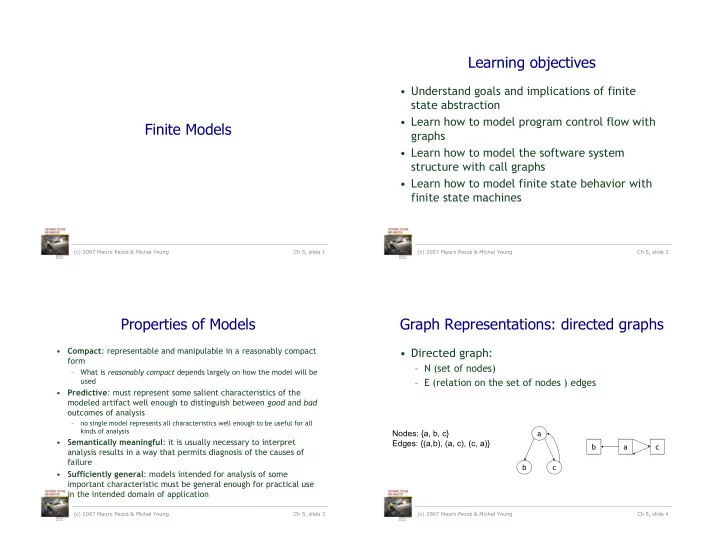
Learning objectives Understand goals and implications of finite state abstraction Learn how to model program control flow with Finite Models graphs Learn how to model the software system structure with call graphs Learn how


slide-1
SLIDE 1

(c) 2007 Mauro Pezzè & Michal Young Ch 5, slide 1

Finite Models

(c) 2007 Mauro Pezzè & Michal Young Ch 5, slide 2

Learning objectives

  • Understand goals and implications of finite

state abstraction

  • Learn how to model program control flow with

graphs

  • Learn how to model the software system

structure with call graphs

  • Learn how to model finite state behavior with

finite state machines

(c) 2007 Mauro Pezzè & Michal Young Ch 5, slide 3

Properties of Models

  • Compact: representable and manipulable in a reasonably compact

form

– What is reasonably compact depends largely on how the model will be used

  • Predictive: must represent some salient characteristics of the

modeled artifact well enough to distinguish between good and bad

  • utcomes of analysis

– no single model represents all characteristics well enough to be useful for all kinds of analysis

  • Semantically meaningful: it is usually necessary to interpret

analysis results in a way that permits diagnosis of the causes of failure

  • Sufficiently general: models intended for analysis of some

important characteristic must be general enough for practical use in the intended domain of application

(c) 2007 Mauro Pezzè & Michal Young Ch 5, slide 4

Graph Representations: directed graphs

  • Directed graph:

– N (set of nodes) – E (relation on the set of nodes ) edges

Nodes: {a, b, c} Edges: {(a,b), (a, c), (c, a)}

a b c b a c

slide-2
SLIDE 2

(c) 2007 Mauro Pezzè & Michal Young Ch 5, slide 5

Graph Representations: labels and code

  • We can label nodes with the names or descriptions of

the entities they represent.

– If nodes a and b represent program regions containing assignment statements, we might draw the two nodes and an edge (a,b) connecting them in this way:

x = y + z; a = f(x);

(c) 2007 Mauro Pezzè & Michal Young Ch 5, slide 6

Multidimensional Graph Representations

  • Sometimes we draw a single diagram to

represent more than one directed graph, drawing the shared nodes only once

– class B extends (is a subclass of) class A – class B has a field that is an object of type C

extends relation NODES = {A, B, C} EDGES = {(A,B)} includes relation NODES = {A, B, C} EDGES = {(B,C)} a b c

(c) 2007 Mauro Pezzè & Michal Young Ch 5, slide 7

Finite Abstraction of Behavior

an abstraction function suppresses some details of program execution

  • it lumps together execution states that differ with respect to the

suppressed details but are otherwise identical

(c) 2007 Mauro Pezzè & Michal Young Ch 5, slide 8

(Intraprocedural) Control Flow Graph

  • nodes = regions of source code (basic blocks)

– Basic block = maximal program region with a single entry and single exit point – Often statements are grouped in single regions to get a compact model – Sometime single statements are broken into more than one node to model control flow within the statement

  • directed edges = possibility that program execution

proceeds from the end of one region directly to the beginning of another

slide-3
SLIDE 3

(c) 2007 Mauro Pezzè & Michal Young Ch 5, slide 9

Example of Control Flow Graph

{ char last = argStr.charAt(0); StringBuffer argBuf = new StringBuffer(); for (int cIdx = 0 ; { char ch = argStr.charAt(cIdx); if (ch != '\n' cIdx < argStr.length(); True True { argBuf .append(ch); last = ch; } True } cIdx++) return argBuf.toString(); } False False || last != '\n') public static String collapseNewlines (String argStr) False b2 b4 b3 b5 b6 b7 b8

public static String collapseNewlines(String argStr) { char last = argStr.charAt(0); StringBuffer argBuf = new StringBuffer(); for (int cIdx = 0 ; cIdx < argStr.length(); cIdx++) { char ch = argStr.charAt(cIdx); if (ch != '\n' || last != '\n') { argBuf.append(ch); last = ch; } } return argBuf.toString(); }

(c) 2007 Mauro Pezzè & Michal Young Ch 5, slide 10

Linear Code Sequence and Jump (LCSJ)

jL b3 b4 b5 b6 b7 jL jE b3 b4 b5 jL jT b3 b4 jL ret b8 jX jL b1 b2 b3 b4 b5 b6 b7 Entry jE b1 b2 b3 b4 b5 Entry jT b1 b2 b3 b4 Entry jX b1 b2 b3 Entry To Sequence of basic blocs From

{ char last = argStr.charAt(0); StringBuffer argBuf = new StringBuffer(); for (int cIdx = 0 ; { char ch = argStr.charAt(cIdx); if (ch != '\n' cIdx < argStr.length(); True True { argBuf .append(ch); last = ch; } True } cIdx++) return argBuf.toString(); } False False || last != '\n') public static String collapseNewlines (String argStr) False b2 b4 b3 b5 b6 b7 b8 b1

jX jT jE jL

Essentially subpaths of the control flow graph from one branch to another

(c) 2007 Mauro Pezzè & Michal Young Ch 5, slide 11

Interprocedural control flow graph

  • Call graphs

– Nodes represent procedures

  • Methods
  • C functions
  • ...

– Edges represent calls relation

(c) 2007 Mauro Pezzè & Michal Young Ch 5, slide 12

Overestimating the calls relation

public class C { public static C cFactory(String kind) { if (kind == "C") return new C(); if (kind == "S") return new S(); return null; } void foo() { System.out.println("You called the parent's method"); } public static void main(String args[]) { (new A()).check(); } } class S extends C { void foo() { System.out.println("You called the child's method"); } } class A { void check() { C myC = C.cFactory("S"); myC.foo(); } }

The static call graph includes calls through dynamic bindings that never occur in execution.

A.check() C.foo() S.foo() CcFactory(string)

slide-4
SLIDE 4

(c) 2007 Mauro Pezzè & Michal Young Ch 5, slide 13

Contex Insensitive Call graphs

public class Context { public static void main(String args[]) { Context c = new Context(); c.foo(3); c.bar(17); } void foo(int n) { int[] myArray = new int[ n ]; depends( myArray, 2) ; } void bar(int n) { int[] myArray = new int[ n ]; depends( myArray, 16) ; } void depends( int[] a, int n ) { a[n] = 42; } }

main C.foo C.bar C.depends

(c) 2007 Mauro Pezzè & Michal Young Ch 5, slide 14

Contex Sensitive Call graphs

public class Context { public static void main(String args[]) { Context c = new Context(); c.foo(3); c.bar(17); } void foo(int n) { int[] myArray = new int[ n ]; depends( myArray, 2) ; } void bar(int n) { int[] myArray = new int[ n ]; depends( myArray, 16) ; } void depends( int[] a, int n ) { a[n] = 42; } }

main C.foo(3) C.bar(17) C.depends(int!3),a,2) C.depends (int!3),a,2)

(c) 2007 Mauro Pezzè & Michal Young Ch 5, slide 15

Context Sensitive CFG exponential growth

A B D F H C E G I J

1 context A 2 contexts AB AC 4 contexts ABD ABE ACD ACE 8 contexts … 16 calling contexts …

(c) 2007 Mauro Pezzè & Michal Young Ch 5, slide 16

Finite state machines

Within line Emty buffer Looking for

  • ptional DOS LF

LF_ emit Done LF_ emit Other char append LF CR_ emit EOF EOF Other char apend CR_ emit EOF emit Other char append e w l d

w/append d/- e/- l w/append d/emit e/emit e/emit w w/append d/- e/emit e/emit e

  • ther

EOF CR LF

  • finite set of states (nodes)
  • set of transitions among states (edges)

Graph representation (Mealy machine) Tabular representation

slide-5
SLIDE 5

(c) 2007 Mauro Pezzè & Michal Young Ch 5, slide 17

Using Models to Reason about System Properties

(c) 2007 Mauro Pezzè & Michal Young Ch 5, slide 18

Abstraction Function

(c) 2007 Mauro Pezzè & Michal Young Ch 5, slide 19

Summary

  • Models must be much simpler than the artifact

they describe to be understandable and analyzable

  • Must also be sufficiently detailed to be useful
  • CFG are built from software
  • FSM can be built before software to

documentintended behavior