Environment and Natural Resources Trust Fund 2012-2013 Request for - - PDF document

environment and natural resources trust fund 2012 2013
SMART_READER_LITE
LIVE PREVIEW

Environment and Natural Resources Trust Fund 2012-2013 Request for - - PDF document

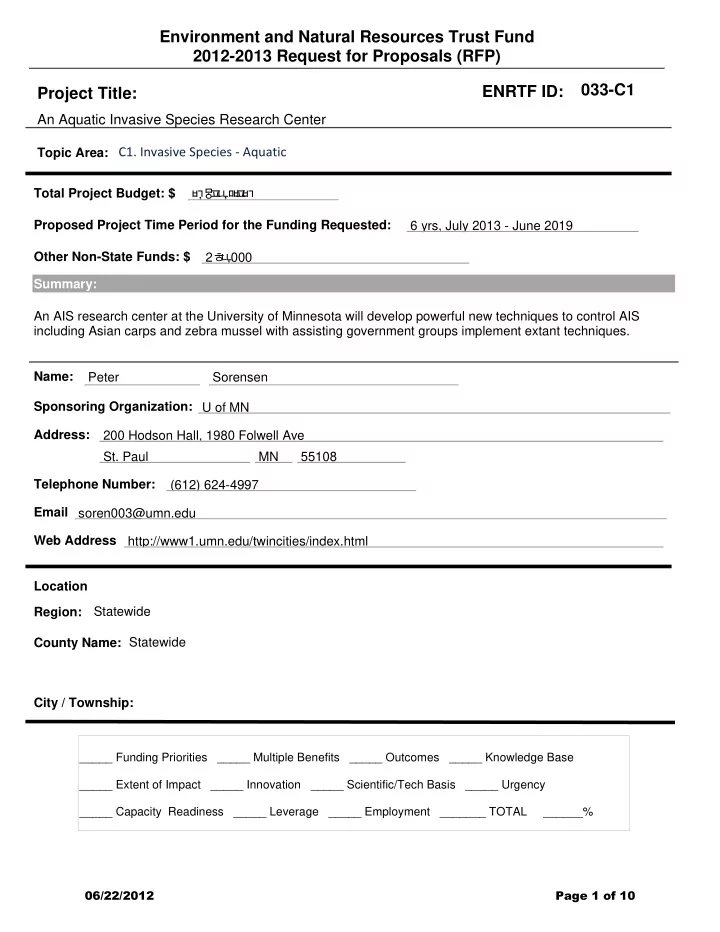
Environment and Natural Resources Trust Fund 2012-2013 Request for Proposals (RFP) 033-C1 ENRTF ID: Project Title: An Aquatic Invasive Species Research Center C1. Invasive Species Aquatic Topic Area: , ,


slide-1
SLIDE 1

Environment and Natural Resources Trust Fund 2012-2013 Request for Proposals (RFP) Project Title:

Total Project Budget: $ Proposed Project Time Period for the Funding Requested: Other Non-State Funds: $ Name: Sponsoring Organization: Address: Telephone Number: Email Web Address County Name: City / Township: Region: Summary: Location

An Aquatic Invasive Species Research Center

  • ,
  • ,
  • 2
  • ,000

6 yrs, July 2013 - June 2019 An AIS research center at the University of Minnesota will develop powerful new techniques to control AIS including Asian carps and zebra mussel with assisting government groups implement extant techniques. Peter U of MN 200 Hodson Hall, 1980 Folwell Ave

  • St. Paul

MN 55108 (612) 624-4997 soren003@umn.edu http://www1.umn.edu/twincities/index.html Statewide Statewide Sorensen

_____ Funding Priorities _____ Multiple Benefits _____ Outcomes _____ Knowledge Base _____ Extent of Impact _____ Innovation _____ Scientific/Tech Basis _____ Urgency _____ Capacity Readiness _____ Leverage _____ Employment _______ TOTAL ______%

  • C1. Invasive Species ‐ Aquatic

ENRTF ID: 033-C1

Topic Area:

06/22/2012 Page 1 of 10

slide-2
SLIDE 2

PROJECT TITLE: An Aquatic Invasive Species Research Center

  • I. PROJECT STATEMENT

Aquatic invasive species (AIS) are causing irreparable damage to Minnesota’s fisheries and wildlife and their habitats, as well as to our outdoor heritage. This threat is expanding as new exotic species arrive, most of them are poorly understood. The Minnesota Department of Natural Resources (DNR) has very limited ability to quantify AIS and few tools to monitor, reduce, and control them. New ideas and approaches are needed to develop real solutions. During the last legislative session the University of Minnesota proposed an AIS Cooperative Research Center to work directly with the DNR and other government organizations. A center offers the most effective, flexible, and cost-efficient way to aggregate expertise and support AIS research while providing critical information to the state. Startup funding ($3.8 million) for the Center was awarded by appropriations from the ENRTF and Clean Water Fund, and the University was asked to apply for operating funds from the ENRTF to give the Center at least a 7-year life span. This proposal is that request for operating funds. Meanwhile, startup funds will be used to renovate the University’s facilities to hold AIS, fund a 6-year program to address zebra mussels, work with the DNR to quantify Asian carp, and establish the Center’s organizational structure. In this proposal, we request funding to continue this startup work while adding new expertise to control and eradicate AIS and to support Extension activities. The Center will address the state’s urgent needs but remain flexible enough to add new programs if/when needed. Its current focus will be zebra mussels, common and Asian carp, and Eurasian watermilfoil as these pose the greatest immediate threats; however, several activities are relevant to all AIS. Emphasis is placed on biocontrol (using native

  • rganisms to control invasive ones) as part of an integrated pest management approach (IPM;

combining multiple tools to address pests) because this has proven most sustainable. However, chemical control of zebra mussels and invasive plants will also be considered. The center will conduct leading-edge research while interacting and collaborating with the DNR and other research and management groups to develop and test promising monitoring and control techniques. Collaboration is important and the administrative structure proposed here encompasses three institutions in addition to three colleges within the University. The DNR is a full partner. Information and techniques will be disseminated by the Extension Service. The Center will focus on critical MN issues and be guided by a broadly-based advisory group while a board of technical experts will provide specific technical advice to Center scientists and the DNR. Work will address all three aspects of AIS control: 1) Delaying AIS spread by disrupting dispersal pathways while monitoring abundance to target success 2) Reducing AIS abundance, and 3) Developing eradication technologies.

  • II. DESCRIPTION OF PROJECT ACTIVITIES

ACTIVITY 1: DELAYING THE SPREAD OF AIS BY DISRUPTING DISPERSAL PATHWAYS WHILE MONITORING ABUNDANCE AND DISTRIBUTION. TOTAL ACTIVITY 1 BUDGET: $1,034,168 No good options exist for quantifying the distribution of aquatic organisms, making control of AIS nearly

  • impossible. We propose to build off Center startup funding to employ environmental DNA (eDNA) to

ascertain presence/absence of a few AIS and develop new techniques that precisely quantify the abundance of many AIS. Specifically, we will develop a metagenomic and sequencing approach to create tools to quantify the presence of thousands of species (vs. just one) in individual water samples. Species of interest will be identified and will include over a dozen AIS as well as key native species (ex. rare mussels) and their microbial communities. We anticipate employing an approach that involves both quantitative PCR and metagenomic assessment of microbial populations associated with AIS. Our goal is

06/22/2012 Page 2 of 10

slide-3
SLIDE 3

to develop a standard set of protocols and data to systematically evaluate the distribution, spread, and effects of key aquatic species in MN waterways across time and space. A new faculty member in the Biotechnology Institute will spearhead this project. Outcome Completion Date

  • 1. Molecular markers for key invasive and native species and

associated microbes will have been developed 2015

  • 2. The utility of the markers for key species validated in mesocosms

2016

  • 3. Markers tested in field experiments

2017

  • 4. State-wide sampling matrix established

2018

  • 5. Analysis of sampling matrix complete

2019 ACTIVITY 2: REDUCING AND CONTROLING AIS. TOTAL ACTIVITY 2 BUDGET: $4,071,232 There are currently no tools other than nonspecific toxins to reduce the number of AIS in large bodies of

  • water. We propose to develop tools and techniques to locate and target invasive fishes and plants, while

startup funds from the Clean Water Fund will support this type of research on zebra mussels as part of an integrated pest management (IPM) approach. Activity 2A. Developing effective tools to locate aggregations of invasive carp. 2A Budget: $940,786. To remove fast-moving invasive fish, we must know where they are. Fortunately, carp are social animals that aggregate. Locating aggregations of carp will be especially useful because the USGS is developing poisoned nanoparticle baits for use in the summer, and seining can be used on natural aggregations in the winter. We will build off existing knowledge of the common carp and then extend it to the Asian

  • carps. Two techniques will be explored to locate aggregations of carps: 1) Following radio-tagged ‘Judas’

fishes as they in turn find others; and 2) inducing aggregations using attractants and/or repellents. Efforts will perfect Judas fish technology and determine where and how common carp move across wetlands so they can be removed. Simultaneously new sensory tools (ex. sex pheromones, sound playback) will be developed to control the behavior and distribution of adult radio-tagged carp. Initial work will focus on silver carp, the most damaging of the Asian carp species. Once these objectives have been completed, we will focus on understanding, manipulating, and removing radio-tagged Asian carp in large rivers. Sterilized fish will be used if our studies find they can be rendered attractive using hormone

  • treatments. This work will be directed by Dr. Peter Sorensen.

Outcome Completion date

  • 1. Distribution and movement of adult common carps in wetlands known

2016

  • 2. Ability to control adult common carp using Judas fish in wetlands established

2017

  • 3. Ability to evoke movement of adult common carp using sex pheromones

2017

  • 4. Ability to use sterile Asian carp as Judas fish in rivers

2018

  • 5. Ability to attract Asian carp with sex pheromones established

2018

  • 6. Ability to locate sexually active silver carp in open rivers using hormone-

implanted Judas fish established 2019 Activity 2B: Developing effective biocontrol techniques to control common and Asian carp. 2B Budget: $1,437,523. Initial work will extend and perfect ongoing research into integrated pest management (IPM) strategies previously funded by watershed districts and the ENRTF to control invasive common carp in several MN lakes by managing native fish that prey on carp eggs, larvae, and young while removing adults when they migrate/aggregate. Then we will test and apply these concepts in wetlands where carp suppress

06/22/2012 Page 3 of 10

slide-4
SLIDE 4

waterfowl populations. Simultaneously, we will determine if Asian carp eggs, larvae, and/or young are also consumed by any native fishes as a first step in determining how biocontrol might eventually be

  • implemented. This field work will likely be conducted in Missouri where these fish are abundant and

chances of success high. Findings will then be tested in ponds to identify the species and densities of native fish needed in MN. Results will be used to create explicit protocols to control silver and common carp and this will be shared with Extension specialists to be implemented. This work will be spearheaded by a new assistant research professor who will collaborate with the fish aggregation (2A) and modeling (2D) teams as well as the USGS. Outcome Completion date

  • 1. Ability of IPM technique to control adult common carp in lakes demonstrated

2015

  • 2. Recruitment dynamics of common carp in waterfowl wetlands through aging

analyses and lake surveys documented 2016

  • 3. Natural mortality and abundance of common carp in wetlands known

2016

  • 4. Native species that might prey on silver carp eggs and young in the field

identified 2017

  • 5. The species/density of native fish needed to control either silver or common

carp in ponds established 2019 Activity 2C: Developing and evaluating new techniques to selectively control invasive plants. 2C Budget: $962,014 U of MN professor and invasive plant expert, Dr. Ray Newman, will work with the DNR to evaluate extant and new strategies to control submersed invasive plants selectively in ways that will also restore native plant communities. Strategies will include use of native herbivorous insects, integrated management with selective chemical or mechanical controls, and techniques to enhance native plant

  • communities. Working with the DNR, at least one chemical treatment to control a species of invasive

plant will also be examined and ecological effects will be evaluated. The focus will be a large-scale, multi-lake manipulation to determine if altering fish community structure can be accomplished to enhance the biological control of Eurasian watermilfoil with milfoil weevils, a species of native herbivorous insect. Previous research funded by ENRTF has shown weevils can control watermilfoil if sunfish do not consume the weevils. Our biocontrol experiment will determine if we can reduce sunfish populations and enhance herbivore populations to control milfoil. Outcome Completion Date

  • 1. Consult with DNR and lake stakeholders and choose potential study lakes

2014

  • 2. Biological control study lakes selected and monitoring selected

2015

  • 3. At least one new chemical weed-control strategy identified (with DNR)

2015

  • 4. Pre-manipulation assessment completed and sunfish manipulation started

2016

  • 5. Test of chemical control of weeds in another lake underway

2017

  • 6. Assessment of fish, herbivore, and plant response to manipulations complete

2018

  • 7. Recommendations on approaches for effective control of aquatic weeds made

2019 Activity 2D: Simulation modeling and risk analysis to identify and evaluate AIS control methods. 2D Budget: $730,909. Simulation models are an efficient and low-cost means of developing and evaluating control scenarios for AIS and predicting outcomes that are prohibitively expensive and risky to determine in the field. We will use models to identify potential control measures, predict the impact of a given control measure (or a combination thereof), and determine how often and how much control we will need for it to be

  • effective. Initial work will be on the common carp because data for these are in hand and this species is

06/22/2012 Page 4 of 10

slide-5
SLIDE 5

extremely damaging. We will then extrapolate to zebra mussels before tackling threats posed by silver carp (the most damaging species of Asian carp). Working with the DNR, we will also use risk analysis to prioritize management actions based on simulation models, habitat suitability, and cost/benefit trade-

  • ffs. This activity will be led by Dr. Paul Venturelli (modeling expert) and Professor David Andow, head of

the U of MN’s risk assessment training program. Outcome Completion date

  • 1. Model developed for common carp management in MN lakes

2014

  • 2. Population viability model to determine impact or degree of control required to

ensure probability of eradicating common carp and zebra mussel from lakes completed 2016

  • 3. Risk assessment models of Asian carp management options completed

2016

  • 4. Age-structured matrix population of silver carp to estimate rates of population

increase and identify facets of life history that can be controlled in MN completed 2017

  • 5. A user-friendly model to control common carp in lakes and wetlands completed

2019 ACTIVITY 3. DEVELOPING TECHNIQUES FOR ERADICATION. TOTAL ACTIVITY 3 BUDGET: $1,392,155 Although ambitious, eradication is our ultimate goal. Only 3 techniques appear capable of achieving it: 1) introduction of exotic predators, 2) introduction or promotion of species-specific pathogens, 3) genetic-engineering and release of AIS. We believe the second option has the most promise in MN. However, using infectious agents to target specific species, such as zebra mussels, is a high-risk, high- reward approach that must be evaluated carefully. This activity will focus on the first step of this evaluation, which is identifying pathogens of native and invasive species that are candidates for AIS

  • control. If successful, future efforts would be needed to test application and risk analysis. Because there

is little research on infectious agents that may be suitable in MN, we will perform an initial survey to identify endogenous infectious agents of native and invasive species and include a variety of fish and mollusk species. The identified agents will be fully characterized by molecular, microbiological, and

  • ther methods to better understand their etiology. From this research, candidate agents suitable for

species-specific control will be identified for further investigation in subsequent proposals. Outcome Completion Date

  • 1. Endogenous infectious agents of native and invasive fish identified

2015

  • 2. Endogenous agents of native and invasive mussels identified

2017 ACTIVITY 4. COORDINATING, SYNERGIZING, PROMOTING, AND APPLYING CENTER EXPERTISE. TOTAL ACTIVITY 4 BUDGET: $2,227,074 The promise of a center lies in its ability to promote synergies, share facilities, and disseminate

  • information. These activities require scientific/administrative leadership and an Extension specialist.

Activity 4A. Coordinating, synergizing, and promoting Center activities. 4A Budget: $931,085 Scientific vitality will be maintained by a technical advisory group which will hold regular workshops with center scientists and outside experts/guests organized by a scientific director (Dr. Sorensen) in consultation with the DNR. Dr. Sorensen will also pursue new funding opportunities, coordinate activities with the Extension Service (Activity 4B), and coordinate Center research activities with the DNR, USGS, and other government bodies. Meanwhile, overall coordination of the Center will be the responsibility of a full-time administrative director. This individual will arrange workshops and meetings with the advisory board, maintain the Center’s specialized facilities, organize the shared technicians that will run these facilities, obtain University and DNR permits required to conduct AIS research, complete

06/22/2012 Page 5 of 10

slide-6
SLIDE 6

ENRTF reports, and coordinate media coverage. Working with the scientific director and Extension specialist, the administrative director will organize a yearly workshop on campus. The first two years of this activity are funded by the ENRTF startup funds. Outcome Completion Date

  • 1. On an annual basis: public symposium series, discussion with advisory group,

workshops with technical advisors and Center scientists, grant writing, AIS permits, LCCMR reports, press releases 2015; 2016; 2017; 2018; 2019 Activity #4B. Implementing Center findings. 4B Budget: $1,295,989 A faculty Extension Specialist will link the scientific advances being made on AIS to the application of knowledge and practices of AIS control throughout MN by working directly with those struggling with AIS control. This individual will develop and implement engagement opportunities and educational programs that will target state and local agencies and organizations (ex. watershed districts). In addition, this position will work directly with Center scientists to implement monitoring and control strategies for AIS at test sites. The DNR and watershed districts will be involved in this process. The

  • verall goal is to create a program that results in a change in condition (management or elimination of

AIS) due to a change in behavior and expectation through increased understanding. Outcome Completion Date

  • 1. Ongoing startup education efforts expanded and consolidated, annual state-

wide workshops on zebra mussel, invasive plants, carp other AIS 2014

  • 2. Application of AIS protocols developed by the Center at a lake test site

2015

  • 3. On an annual basis: outstate workshops on AIS; educational materials

developed and distributed 2015; 2016; 2017; 2018; 2019

  • 4. Application of AIS protocols developed by the Center at a wetlands test site

2016

  • 5. Application of eDNA protocols developed by the Center

2018

  • III. PROJECT STRATEGY
  • A. Project Team/Partners

The DNR is a partner and will actively share staff, funding and expertise across all activities of this project including eDNA, carp management and invasive plant management. Riley Purgatory Bluff Creek Watershed District funds carp management research by the U of MN in its wetlands and that will

  • continue. Collaborations with the USGS are also expected to continue. The National Science Foundation

will continue to fund robotics to track Judas carp. Marone Inc., a company that produces experimental zebra mussel toxins, has offered the Center product and assistance as has Ovivo, a fish barrier company. These partners will contribute funds, supplies and equipment in exchange for Center expertise.

  • B. Timeline Requirements

The objective of the Center is to establish and develop new expertise in a discipline that presently has

  • little. We need to recruit new, young professionals to the University and support them so they can

develop new approaches. Minnesota’s variable climate and the fact that many AIS are long lived (ex. carp up to 60 yrs) mandates long-term approaches. At least 6 years is required to accomplish this task.

  • C. Long-Term Strategy and Future Funding Needs

The Center will address urgent AIS problems in MN while being flexible and able to address new ones in the future. While the Center will become increasingly self-supporting with time (assistant professors will be expected to apply for outside funding), our focus is on local issues, and requests for funding to the LCCMR and other state agencies can be expected in the future. We do not see the need for this Center diminishing in the near future.

06/22/2012 Page 6 of 10

slide-7
SLIDE 7

BUDGET ITEM Personnel: 4 Professors - Salary + Fringe [Sadowsky Activity (#1A, 1 week/yr); Sorensen (Activity #2A, 2 mo/yr); Newman (Activity #2C, 1 mo/yr); Andow (Activity#2D, risk assessment, 2wks/yr)] 1 Assistant Professor - Salary + Fringe [Venturelli (Activity #2D, 1 mo/yr)] 4 Research Assistant Professors - Salary + Fringe [Metagenomics (Activity #1A, fulltime); Fish Ecology/IPM (Activity #2B); Pathogens (Activity #3A, fulltime, 4yrs); Center Activities (Activity #4B, Extension, fulltime)] 3 Postdoctoral Fellows - Salary + Fringe [Fish behavior/Judas fish (Activity# 2A); (Activity #2C); (Activity #2D)] Scientific Director - Salary + Fringe Administrative Director - Salary + Fringe 3 Lab Technicians - Salary + Fringe 7 Graduate Students - Salary + Fringe Undergraduate students - Salary + Fringe Equipment/Tools/Supplies: Metagenomics (Activity #1 A w startup) Fish Behavior/aggregation (Activity #2A, radiotags, receiver, pheromones) Fish ecology/IPM (Actiivty #2B; field supplies, newts, gas) Modelling (Activity #2D, computers, software, risk and simualtion) Invasive plants (Activity #2C gas, nets, bags,etc) Pathogens (Activity#3A) Organization (computer and related supplies; Activity #4A Extension (Activity #4B; field supplies) Travel: Metageomics (Activity #1A; sampling, conferences) Fish Behavior, biochemistry (Activity #2A, experiments for 2 conferences) Fish Ecology (#2B; sampling MN, then MI, then MN house rent, van,air, food) Modeling (Activity #2D) Invasive plants (#2C Pathogens (Activity#3A) Organization (#4A; meetings, expert advisors) Extension (travel, conferences, experiments; Activity #4B) Additional Budget Items: Services (qPCR machine contract, sequencing, repairs) (Activity #1) Radio-receivers, Services (Biochemistry) (Activity #2A) Pond rental with fish and technician (USGS reimbursable; Activity #2B) Oxygen meter, GPS (Activity #2C) Equipment repairs( Shared between 7 Activities) TOTAL ENVIRONMENT AND NATURAL RESOURCES TRUST FUND $ REQUEST = SOURCE OF FUNDS AMOUNT Status Other Non-State $ Being Applied to Project During Project Period: National Science Foundation grant on carp tracking 234,000 $ Secured Other State $ Being Applied to Project During Project Period: ML 2012 appropriations from ENRTF ($2,000,000) and Clean Water Fund ($1,800,000) for Center startup 3,800,000 $ Secured In-kind Services During Project Period: The DNR will provide facilities, boats and personnel as partners. The University of Minnesota will provide general overhead, accounting, and building maintenance.

  • $

Secured Remaining $ from Current ENRTF Appropriation (if applicable): ML 2012 appropriation to begin July 1, 2012 2,000,000 $ Secured Funding History: ENRTF (Integrated and pheromonal control of carp; 2005-2008 $550,000), ENRTF (Accelerating plans for integrated carp control, 2008-2011; $550,000); ENRTF (Controlling movement of invasive fish; 2009-2012; $300,000 [Sorensen co-PI]) 1,400,000 $ 30,000 $ 60,000 $ 45,000 $ 30,000 $ 25,000 $ 90,000 $ 60,000 $ 41,836 $ 54,360 $ 115,000 $ 30,000 $ 150,000 $ 6,000 $ 564,799 $ 1,241,104 $ 1,235,259 $ 380,000 $ 25,000 $ 100,000 $

  • V. OTHER FUNDS

7,022,432 $ 8,724,628 $ 965,000 $ 100,000 $ 66,159 $ 2,263,570 $ 351,393 $ 120,000 $ 120,000 $

2012-2013 Detailed Project Budget

  • IV. TOTAL ENRTF REQUEST BUDGET: 6 years (See Attachment for Budget Detail)

AMOUNT 213,256 $ 461,196 $ 276,000 $ 60,000 $ 60,000 $ 770,607 $ 316,287 $

06/22/2012 Page 7 of 10

slide-8
SLIDE 8

PROPOSAL: An Aquatic Invasive Species Research Center Detailed Budget by Project Year Budget: 2012 LCCMR Proposal Year 1 Year 2 Year 3 Year 4 Year 5 Year 6 TOTAL PROJECT DURATION: 1 July 2013 - 30 June 2019 2013-2014 2014-2015 2015-2016 2016-2017 2017-2018 2018-2019 BUDGET Personnel: Research Assistant Professor #1 - Metagenomics (Activity #1A, fulltime) $0 $0 $85,000 $87,550 $90,177 $92,882 $355,608 Graduate student#1 (Activity #1)A $0 $0 $20,550 $21,167 $21,801 $22,456 $85,974 Michael Sadowsky (Activity #1A, 1 week/yr) $0 $0 $8,742 $9,004 $9,274 $9,553 $36,573 Peter Sorensen- Fish behavior/aggregation (Activity #2A, 2 mo/yr) $0 $0 29,916 30813 31738 32690 125,157 Postdoc#1- fish behavior/Judas fish (Activity# 2A) $0 $0 46,680 48080 49523 51008 195,292 Graduate Student#2 (Behavior; Activity #2A) $0 $0 $20,550 $21,167 $21,801 $22,456 $85,974 Research Assistant Professor #2 - fish ecology/ IPM (Activity #2B) $38,000 $76,000 $78,280 $80,628 $83,047 $85,539 $441,494 Graduate Students #3,4 (Ecology; 1 -6 yrs, 2 - 2 yrs; Activity #2B) $19,570 $20,157 $41,524 $42,769 $22,026 $22,687 $168,733 Paul Venturelli - Modeler (Activity #2D, 1 mo) $7,650 $7,880 $8,116 $8,359 $8,610 $8,868 $49,483 Graduate Student#5 (Activity #2D) $19,750 $20,343 $20,953 $21,581 $22,229 $22,896 $127,751 Ray Newman (1mo) (Activity #2C, 1 mo) $10,872 $11,198 $11,534 $11,880 $12,237 $12,604 $70,325 Postdoctoral fellow#2 (Activity #2C) $45,000 $46,350 $47,741 $49,173 $50,648 $52,167 $291,078 Undergraduates (Activity #2C;4 fulltime summer, 2 halftime winter) $28,920 $29,788 $30,681 $31,602 $32,550 $33,526 $187,066 2 Field and fish care technicans (ALL Field and lab activities) $105,000 $108,150 $127,000 $130,810 $134,734 $138,776 $744,471 Research Assistant Professor#3 - Pathogens (Activity #3A, fulltime, 4yrs) $85,000 $87,550 $90,177 $92,882 $0 $0 $355,608 Senior Lab technician (activity #3A) $32,000 $32,960 $33,949 $34,967 $0 $0 $133,876 Graduate student#6 (Activity#3A) $22,506 $23,181 $23,877 $24,593 $0 $0 $94,157 David Andow (Activity#2D, risk assessment, 2wks.yr) $12,000 $12,360 $0 $0 $0 $0 $24,360 Postdoctoral fellow#3 (Activity #2D-) $45,000 $45,000 $0 $0 $0 $0 $90,000 Scientific Director (Activity #4A, first year aid startyup, 3 mo/yr) $0 $44,558 $45,895 $47,272 $48,690 $50,150 $236,564 Administrative Director (Activity #4A) $0 $79,568 $81,955 $84,414 $86,946 $89,554 $422,437 New Research Assistant Prof#4 (Activity #4B, Extension, fulltime) $83,000 $85,490 $88,055 $90,696 $93,417 $96,220 $536,878 Graduate Student #7 Activity #4B) $19,750 $20,343 $20,953 $21,581 $22,229 $22,896 $127,751 Fringe: Research Assistant Professor#1 (Activity #1A) $0 $0 $28,645 $29,504 $30,389 $31,301 $119,840 Graduate student #1 w/tuition (Activity #1A) $0 $0 $16,704 $16,808 $16,914 $17,024 $67,449 Michael Sadowsky (Activity #1) $0 $0 $2,946 $3,034 $3,125 $3,219 $12,325 Peter Sorensen- Fish behavior/aggregation(Activity #2, 1mo) $0 $0 $10,082 $10,384 $10,696 $11,017 $42,178 Postdoc (Activity#2) $0 $0 $15,731 $16,203 $16,689 $17,190 $65,813 Grad Student (Activity #2) $0 $0 $16,704 $16,808 $16,914 $17,024 $67,449 Research Assistant Professor #2B (fish ecology IPM, Activity #3) $13,680 $27,360 $26,380 $27,172 $27,987 $30,794 $153,373 Graduate Students w/tuition (Activity #2B) $16,540 $16,638 $33,479 $33,688 $16,952 $17,062 $134,360 Paul Venturelli (Activity #2D) $2,578 $2,655 $2,735 $2,817 $2,902 $2,989 $16,676 Graduate student w/tuition (Activity #2D) $16,570 $16,669 $16,772 $16,877 $16,986 $17,097 $100,971 Ray Newman (Activity 2C) $3,664 $3,774 $3,887 $4,004 $4,124 $4,247 $23,699 Postdoctoral fellow#2 (Activity #2C) $15,165 $15,620 $16,089 $16,571 $17,068 $17,580 $98,093 Undergraduates (Activity #2C) $4,049 $4,170 $4,295 $4,424 $4,557 $4,694 $26,189 2 field and fish care technicans (ALL ACTIVITIES) frg @ 41.3% $43,365 $44,666 $52,451 $54,025 $55,645 $57,315 $307,466 Research Assistant Profesor (Activity #3A) $28,645 $29,504 $30,389 $31,301 $0 $0 $119,840 Senior Lab technican (#3A) frg@41.3 $13,216 $13,612 $14,021 $14,441 $0 $0 $55,291 Graduate Student (#3A) $17,032 $17,145 $17,262 $17,382 $0 $0 $68,821 David Andow (#2D, risk assessment) $4,044 $12,731 $0 $0 $0 $0 $16,775 Postdoctoral fellow#3 (Activity #2D) $15,165 $15,165 $0 $0 $0 $0 $30,330 Scientific Director (first year paid with startup) (#4A) $0 $15,016 $15,467 $15,931 $16,408 $16,901 $79,722 Administrative Director (Activity#4A) $0 $26,814 $27,619 $28,447 $29,301 $30,180 $142,361 New Research Assistant Professor (Activity #4B, Extension) $27,971 $28,810 $29,674 $30,565 $31,482 $32,426 $180,928 Graduate Student w/tuition (Activity #4B) $16,570 $16,669 $21,670 $16,877 $16,986 $17,097 $105,870 Total salary and fringe $812,272 $1,057,895 $1,365,128 $1,398,252 $1,176,801 $1,212,084 $7,022,432 SUPPLIES: Metagenomics (Activity #1 Aw startup) $0 $0 $25,000 $25,000 $25,000 $25,000 $100,000 Fish Behavior/aggregation (Activity #2A, radiotags, receiver, pheromones) $0 $0 $30,000 $30,000 $30,000 $30,000 $120,000 Fish ecology/IPM (Actiivty #2B; field supplies, newts, gas) $15,000 $15,000 $30,000 $30,000 $15,000 $15,000 $120,000 Modelling (Activity #2D, computers, software, risk and simualtion) $20,000 $20,000 $5,000 $5,000 $5,000 $5,000 $60,000 Invasive plants (Activity #2C gas, nets, bags,etc) $10,000 $10,000 $10,000 $10,000 $10,000 $10,000 $60,000 Pathogens (Activity#3A) $95,000 $95,000 $95,000 $95,000 $0 $0 $380,000 Administration (computer and related supplies; Activity #4A $0 $5,000 $5,000 $5,000 $5,000 $5,000 $25,000 Extension (Activity #4B; field supplies) $50,000 $10,000 $10,000 $10,000 $10,000 $10,000 $100,000 Total Supplies $190,000 $155,000 $210,000 $210,000 $100,000 $100,000 $965,000 TRAVEL Metageomics (Activity #1A; sampling, conferences) $0 $0 $10,000 $10,300 $10,609 $10,927 $41,836 Fish Behavior, biochemistry (Activity #2A, experiments for 2 conferences) $0 $0 $12,000 $12,360 $15,000 $15,000 $54,360 Fish Ecology (#2B; sampling MN, then MI, then MN house rent, van,air, food $10,000 $10,000 $20,000 $25,000 $25,000 $25,000 $115,000 Modeling (Activity #2D) $15,000 $15,000 $7,500 $7,500 $7,500 $7,500 $60,000 Invasive plants (#2C $7,500 $7,500 $7,500 $7,500 $7,500 $7,500 $45,000 Pathogens (Activity#3A) $7,500 $7,500 $7,500 $7,500 $0 $0 $30,000 Administration (#4A; meetings, expert advisors) $0 $5,000 $5,000 $5,000 $5,000 $5,000 $25,000 Extension (travel, conferences, experiments; Activity #4B) $15,000 $15,000 $15,000 $15,000 $15,000 $15,000 $90,000 Total Travel $55,000 $60,000 $84,500 $90,160 $85,609 $85,927 $461,196 OTHER DIRECT COSTS: Services (qPCR machine contract, sequencing, repairs) (Activity #1) $0 $0 $15,000 $15,000 $15,000 $15,000 $60,000 Radio-receivers, Services (Biochemistry) (Activity #2A) $0 $0 $15,000 $5,000 $5,000 $5,000 $30,000 Pond rental with fish and technician (USGS reimbursable; Activity #2B) $0 $0 $50,000 $50,000 $50,000 $0 $150,000 Oxygen meter, GPS (Activity #2C) $6,000 $0 $0 $0 $0 $0 $6,000 Equipment repairs( All Activitiies; field and lab, divided by 7) $5,000 $5,000 $5,000 $5,000 $5,000 $5,000 $30,000 Total Other Direct Costs $11,000 $5,000 $85,000 $75,000 $75,000 $25,000 $276,000 TOTAL DIRECT COSTS $1,068,272 $1,277,895 $1,744,628 $1,773,412 $1,437,410 $1,423,011 $8,724,628

06/22/2012 Page 8 of 10
slide-9
SLIDE 9

U of M Aquatic Invasive Species Cooperative Research Center

ACTIVITY Clean Water Fund ML 2012 Appropriation 2012-2018 ENRTF ML 2012 Appropriation 2012-2018 ENRTF 6 Year Request 2013-2019 AIS Organization/Center Operations and Coordination and Implementation of Findings (including workshops, dissemination) $390,611 $931,085 Lab/Facility Refurbishment $575,000 $565,000 Zebra Mussel Control Research $1,215,000 AIS Abundance and Distribution Research (eDNA) $678,772 $1,034,168 Carp Aggregation and attractant Research (Common and Asian) $341,546 $940,786 Carp Biocontrol Research (Common and Asian) $1,437,523 Invasive Plant Control Research $962,014 Modeling and Evaluation of Control Techniques for Risk Analysis (carp, zebra mussels) $730,909 Pathogen Identification for AIS Control Candidates $1,392,155 Extension and Outreach $10,000 $1,295,989 VHS Screening $24,071 Total $1,800,000 $2,000,000 $8,724,629 The entire state is threatened by AIS and of interest to the Center. Of immediate concern is Asian carp (whose DNA has been detected several dozen times in lower portions of the Mississippi and St Croix rivers in the past year), the zebra mussel (now present in several hundred lakes), common carp (present in thousands of shallow lakes and wetlands in the southern third of the state), and Eurasian water milfoil (present in many hundreds of lakes in the Mississippi River drainage). While the Center will initially focus on these, it will also address other AIS if/as advised by its advisory group (ex. curly-leaf pondweed) or if they suddenly become a threat (ex. quagga mussel).

Funding Summary

06/22/2012 Page 9 of 10

slide-10
SLIDE 10

PROJECT MANAGER & ORGANIZATION DESCRIPTION ATTACHMENT Professor Peter Sorensen will assume overall responsibility for the Center. Specifically, he will serve as its scientific director and oversee the activities of an administrative director (identity not determined). The Center will be based in the College of Food Agriculture and Natural Resource Sciences (CFANS) on the St. Paul campus but will include at least 3 other colleges and many partners including the DNR. Dr. Sorensen will receive broad guidance from an advisory commission that will contain representatives from the DNR, federal government (USGS, FWS) as well as watershed districts and other stakeholders. This group will meet at least once a year and the DNR will likely be a chair (it will be full partner). In addition, Dr. Sorensen will head a technical advisory committee that will meet several times a year and be comprised of scientific experts from agencies as well as Center scientists. It will provide specific technical advice to the Center and DNR. The Center will be comprised of 8 scientific teams although this number will be evaluated each year and could change. These teams will each have at least one student and/or postdoctoral fellow and meet on a quarterly basis to exchange ideas and information. Teams will also share a central AIS research lab as well as field equipment and three technicians. An Extension specialist will educate and implement the Center’s findings so considerable efficiencies and synergism is

  • expected. Day-to-day operations will be under the guidance of a fulltime administrative director. The

administrative director will organize advisory board meetings, annual workshops for the public, manage staff hours, coordinate reports, obtain AIS permits from the DNR, assist with grant proposals, and coordinate press coverage. PETER W. SORENSEN, PROJECT MANAGER (SCIENTIFIC DIRECTOR) Department of Fisheries, Wildlife & Conservation Biology, University of Minnesota Interests and expertise: Peter is interested in the physiological basis of fish behavior and its ramifications for controlling invasive

  • fish. Pheromones, chemical signals that pass between members of the same species, are of special

interest as is their influence of fish movement and distribution. He has been studying invasive fish since 1989. Professional preparation: Bates College (Maine), Biology, B.A. 1976 University of Rhode Island, Biological Oceanography, Ph.D., 1984 University of Alberta, Zoology/Medical Science, Postdoctoral Fellow, 1984-1988. Recent experience: Assistant professor, 1988- 1993 Associate professor, 1993-1997 Professor, 1997- Grant management: Dr. Sorensen has received nearly 60 competitive grants while at the University of Minnesota and over 6 million dollars. Publications: 122 peer-reviewed publications, 20 book chapters, 1 patent (sea lamprey pheromone identification and its use in control), 25+ non-peer reviewed publications Graduate students: 21 total, 19 postdocs Teaching: Fish Physiology & Behavior, Marine Biology

06/22/2012 Page 10 of 10