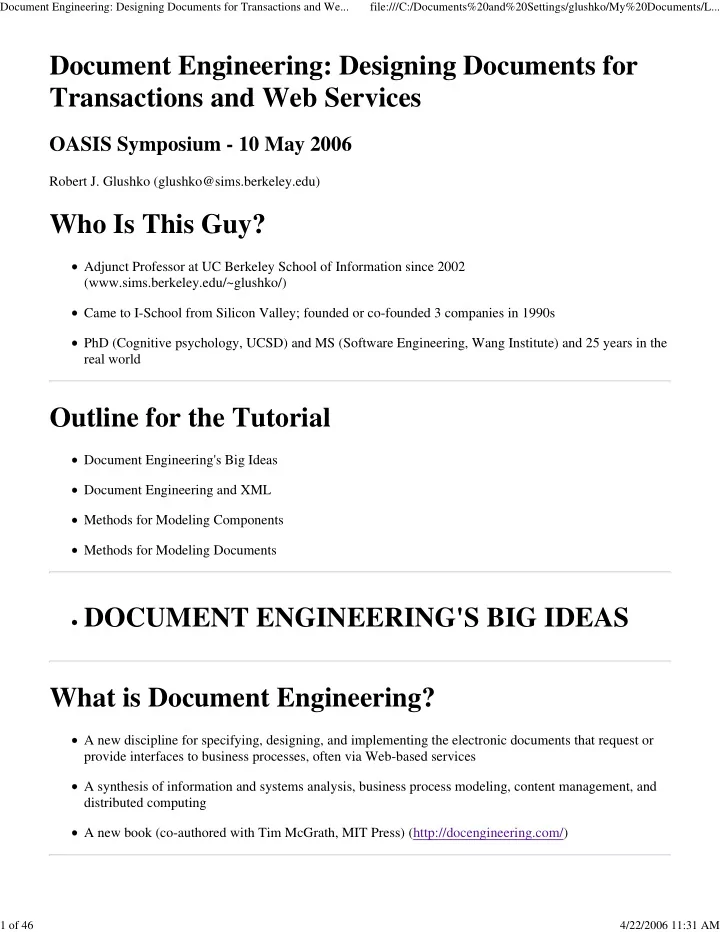
Document Engineering: Designing Documents for Transactions and We... file:///C:/Documents%20and%20Settings/glushko/My%20Documents/L... Document Engineering: Designing Documents for Transactions and Web Services OASIS Symposium - 10 May 2006 Robert J. Glushko (glushko@sims.berkeley.edu) Who Is This Guy? Adjunct Professor at UC Berkeley School of Information since 2002 (www.sims.berkeley.edu/~glushko/) Came to I-School from Silicon Valley; founded or co-founded 3 companies in 1990s PhD (Cognitive psychology, UCSD) and MS (Software Engineering, Wang Institute) and 25 years in the real world Outline for the Tutorial Document Engineering's Big Ideas Document Engineering and XML Methods for Modeling Components Methods for Modeling Documents DOCUMENT ENGINEERING'S BIG IDEAS What is Document Engineering? A new discipline for specifying, designing, and implementing the electronic documents that request or provide interfaces to business processes, often via Web-based services A synthesis of information and systems analysis, business process modeling, content management, and distributed computing A new book (co-authored with Tim McGrath, MIT Press) (http://docengineering.com/) 1 of 46 4/22/2006 11:31 AM
Document Engineering: Designing Documents for Transactions and We... file:///C:/Documents%20and%20Settings/glushko/My%20Documents/L... Document Engineering - The Book Motivating "Document Engineering" Scenario: Customer selects book from catalog on an online bookstore Customer pays with credit card Book arrives via express shipper two days later From the customer's perspective there is only one "transaction" But the bookstore is a virtual enterprise that follows the drop shipment pattern to coordinate the activities of 4 different service providers transacting with each other This coordination - or choreography - is carried out with document exchanges 2 of 46 4/22/2006 11:31 AM
Document Engineering: Designing Documents for Transactions and We... file:///C:/Documents%20and%20Settings/glushko/My%20Documents/L... The Virtual Bookstore Overlapping Information Models in the Virtual Bookstore 3 of 46 4/22/2006 11:31 AM
Document Engineering: Designing Documents for Transactions and We... file:///C:/Documents%20and%20Settings/glushko/My%20Documents/L... An Ancient Business Document Document Exchange Patterns 4 of 46 4/22/2006 11:31 AM
Document Engineering: Designing Documents for Transactions and We... file:///C:/Documents%20and%20Settings/glushko/My%20Documents/L... Halfat's clay pot receipt for taxes is certainly one of the oldest documents that record a business transaction (355 BCE) Businesses have long dealt with each other by exchanging documents We use concepts like "supply chains" and "distribution channels" as metaphors for the coordinated or choreographed flow of information and materials/products between businesses These are complex patterns composed from the document exchange pattern The Evolution of "Business Architectures" for Document Exchange The technology for business documents has changed throughout history, but the basic idea of document exchange has changed relatively little For over two thousand years the "business architecture" around the exchange of documents was non-proprietary and loosely-coupled Neither party to the exchange needed to know how the other produced or understood the documents A very short time period (evolutionarily speaking) from about 1950-1995 used proprietary and tightly-coupled business architecture Document Engineering as the Methodology for Exploiting the Internet as a Business Application Platform But being non-proprietary and loosely-coupled isn't sufficient for a successful document exchange – exchanging information does no good if the information can't be understood by the parties (or applications) doing the exchanging. The Web services "standards" not only don't solve this problem – they completely ignore it Document Engineering will ensure that the documents can be understood Document Exchange is the Mother of All Patterns Document exchange is the "mother of all patterns" for business models, business processes, and business information: Business model or organizational patterns: marketplace, auction, supply chain, build to order, drop shipment, vendor managed inventory, etc. 5 of 46 4/22/2006 11:31 AM
Document Engineering: Designing Documents for Transactions and We... file:///C:/Documents%20and%20Settings/glushko/My%20Documents/L... Business process patterns: procurement, payment, shipment, reconciliation, etc. Business information patterns: catalog, purchase order, invoice, etc. and the components they contain for party, time, location, measurement, etc. The Model Matrix The "Pattern Compass" 6 of 46 4/22/2006 11:31 AM
Document Engineering: Designing Documents for Transactions and We... file:///C:/Documents%20and%20Settings/glushko/My%20Documents/L... Patterns in Document Engineering The essence of Document Engineering is its systematic approach for discovering and exploiting the relationships between patterns of different types Working from the top down to ensure that a business model is feasible Working from the bottom up to ensure that we are designing and optimizing the activities that add the most value We need models of the desired business processes and the documents that they will produce and consume at the same level of detail and implementability Meeting in the Middle [1] We need to achieve both business and technical interoperability – the former is necessary but insufficient for the latter We need models of the desired business processes and the documents that they will produce and consume at the same level of detail and implementability 7 of 46 4/22/2006 11:31 AM
Document Engineering: Designing Documents for Transactions and We... file:///C:/Documents%20and%20Settings/glushko/My%20Documents/L... This is represented in the Model Matrix as "meeting in the middle" Document Engineering is a systematic approach for "getting to the middle" Meeting in the Middle [2] The Document Engineering Approach 8 of 46 4/22/2006 11:31 AM
Document Engineering: Designing Documents for Transactions and We... file:///C:/Documents%20and%20Settings/glushko/My%20Documents/L... A Checklist for Describing Projects and Case Studies D -- data types and document types O -- organizational processes C -- context (types of products or services, industry, geography, regulatory considerations) U -- user types and special user requirements M -- models, patterns, or standards that apply E -- enterprises and eco systems (e.g., trading communities, standards bodies) N -- the needs (business case) driving the enterprise(s) T -- technology constraints and opportunities D-O-C-U-M-E-N-T in the Document Engineering Approach 9 of 46 4/22/2006 11:31 AM
Document Engineering: Designing Documents for Transactions and We... file:///C:/Documents%20and%20Settings/glushko/My%20Documents/L... Modeling Documents {and,vs,or} Modeling Processes Documents are always the result of some process and often the input to another one This is most evident for transactional documents where patterns of paired document exchange are the building blocks for supply chains, marketplaces, auctions and other business patterns By understanding the information in the documents, we learn what kinds of processes are possible By understanding the processes, we learn what kinds of information are needed A Process-Centric Depiction 10 of 46 4/22/2006 11:31 AM
Document Engineering: Designing Documents for Transactions and We... file:///C:/Documents%20and%20Settings/glushko/My%20Documents/L... A Document-Centric Depiction Benefits of a Document-Centric Modeling Approach Documents are more tangible than processes, easier to analyze and communicate 11 of 46 4/22/2006 11:31 AM
Document Engineering: Designing Documents for Transactions and We... file:///C:/Documents%20and%20Settings/glushko/My%20Documents/L... SOA emphasizes documents as the public interfaces to private processes David Cohn: 100,000 nouns enable us to understand the meanings of 10,000 verbs DOCUMENT ENGINEERING AND XML Document Engineering Isn't Just About XML XML is a useful technology for Document Engineering, but using XML doesn't make you a document engineer The best thing about XML is the ease with which you can create a new vocabulary for a particular type of document XML is just the syntax in which we encode document models... what really matters is how we modeled the documents Creating Models is Easy, But Creating GOOD Models is Hard The worst thing about XML is the same as the best thing – the ease with which you can create a new vocabulary No way around the classical problems of classification and naming we know from philosophy, linguistics, cognitive psychology, and information science XML is NOT "self-describing" There are often multiple vocabularies for the same or related domains and especially for the common information models that are used in more than one domain The Equivalence Problem 12 of 46 4/22/2006 11:31 AM
Document Engineering: Designing Documents for Transactions and We... file:///C:/Documents%20and%20Settings/glushko/My%20Documents/L... The Target Model For The Interoperability Scenarios 13 of 46 4/22/2006 11:31 AM
Recommend
More recommend
 Sambuz
Unleash a World of Digital Possibilities—Browse, Share, and Explore Content Without Boundaries