Distributed Transaction Management Database Management Systems, 2 nd - - PDF document

distributed transaction management
SMART_READER_LITE
LIVE PREVIEW

Distributed Transaction Management Database Management Systems, 2 nd - - PDF document

Distributed Transaction Management Database Management Systems, 2 nd Edition. R. Ramakrishnan and Johannes Gehrke 1 Distributed Concurrency Control Use global 2PL Or, simply use local Strict 2PL at each site Database Management


slide-1
SLIDE 1

1

Database Management Systems, 2nd Edition. R. Ramakrishnan and Johannes Gehrke 1

Distributed Transaction Management

Database Management Systems, 2nd Edition. R. Ramakrishnan and Johannes Gehrke 2

Distributed Concurrency Control

Use “global” 2PL Or, simply use “local” Strict 2PL at each site

Database Management Systems, 2nd Edition. R. Ramakrishnan and Johannes Gehrke 3

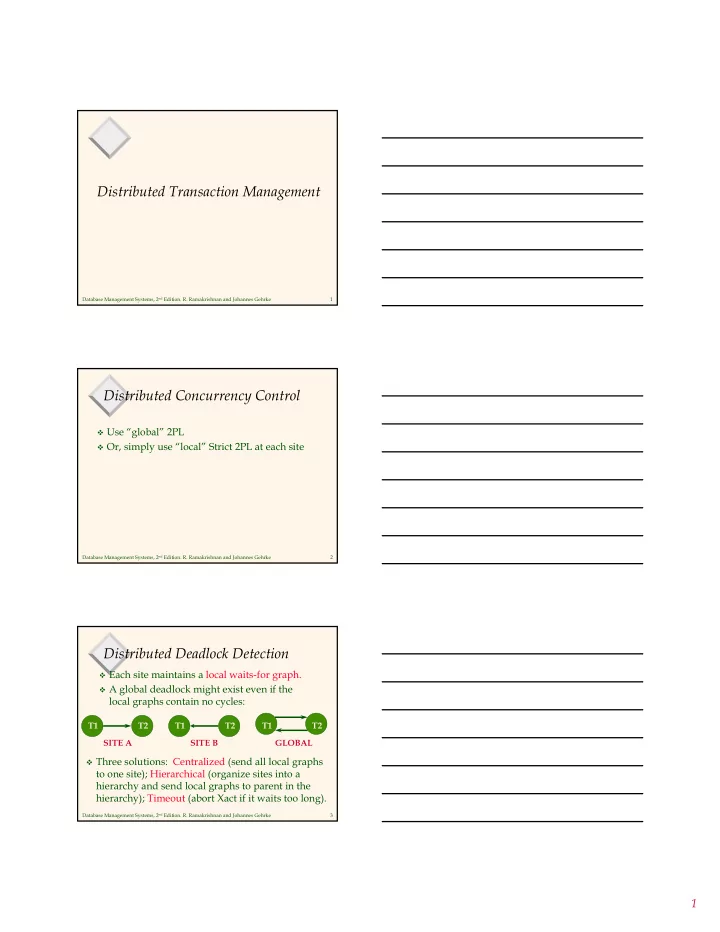
Distributed Deadlock Detection

Each site maintains a local waits-for graph. A global deadlock might exist even if the

local graphs contain no cycles:

T1 T1 T1 T2 T2 T2 SITE A SITE B GLOBAL

Three solutions: Centralized (send all local graphs

to one site); Hierarchical (organize sites into a hierarchy and send local graphs to parent in the hierarchy); Timeout (abort Xact if it waits too long).

slide-2
SLIDE 2

2

Database Management Systems, 2nd Edition. R. Ramakrishnan and Johannes Gehrke 4

Distributed Recovery

Two new issues:

– New kinds of failure, e.g., links and remote sites – If “sub-transactions” of an Xact execute at different sites, all or none must commit. Need a commit protocol to achieve this.

Database Management Systems, 2nd Edition. R. Ramakrishnan and Johannes Gehrke 5

Two-Phase Commit

Coordinator Subordinate

Send prepare Force-write prepare record Send yes or no Wait for all responses Force-write commit or abort Send commit or abort Force-write abort or commit Send ACK Wait for all ACKs Write end record

Database Management Systems, 2nd Edition. R. Ramakrishnan and Johannes Gehrke 6

Comments on 2PC

Two rounds of communication: First, voting; then,

  • termination. Both initiated by coordinator.

Any site can decide to abort an Xact. Every msg reflects a decision by the sender; to

ensure that this decision survives failures, it is first recorded in the local log.

All commit protocol log recs for an Xact contain

Xactid and Coordinatorid. The coordinator’s abort/commit record also includes ids of all subordinates.

slide-3
SLIDE 3

3

Database Management Systems, 2nd Edition. R. Ramakrishnan and Johannes Gehrke 7

Restart After a Failure at a Site

If we have a commit or abort log rec for Xact T, but

not an end rec, must redo/undo T.

– If this site is the coordinator for T, keep sending commit/abort msgs to subs until acks received.

If we have a prepare log rec for Xact T, but not

commit/abort, this site is a subordinate for T.

– Repeatedly contact the coordinator to find status of T, then write commit/abort log rec; redo/undo T; and write end log rec.

If we don’t have even a prepare log rec for T,

unilaterally abort and undo T.

– This site may be coordinator! If so, subs may send msgs.

Database Management Systems, 2nd Edition. R. Ramakrishnan and Johannes Gehrke 8

Blocking

If coordinator for Xact T fails, subordinates

who have voted yes cannot decide whether to commit or abort T until coordinator recovers. – T is blocked. – Even if all subordinates know each other (extra overhead in prepare msg) they are blocked unless one of them voted no.

Database Management Systems, 2nd Edition. R. Ramakrishnan and Johannes Gehrke 9

Link and Remote Site Failures

If a remote site does not respond during the

commit protocol for Xact T, either because the site failed or the link failed: – If the current site is the coordinator for T, should abort T. – If the current site is a subordinate, and has not yet voted yes, it should abort T. – If the current site is a subordinate and has voted yes, it is blocked until the coordinator responds.

slide-4
SLIDE 4

4

Database Management Systems, 2nd Edition. R. Ramakrishnan and Johannes Gehrke 10

Observations on 2PC

Ack msgs used to let coordinator know when

it can “forget” an Xact; until it receives all acks, it must keep T in the Xact Table.

If coordinator fails after sending prepare

msgs but before writing commit/abort log recs, when it comes back up it aborts the Xact.

If a subtransaction does no updates, its

commit or abort status is irrelevant.

Database Management Systems, 2nd Edition. R. Ramakrishnan and Johannes Gehrke 11

2PC with Presumed Abort

When coordinator aborts T, it undoes T and

removes it from the Xact Table immediately.

– Doesn’t wait for acks; “presumes abort” if Xact not in Xact Table. Names of subs not recorded in abort log rec.

Subordinates do not send acks on abort. If subxact does not do updates, it responds to

prepare msg with reader instead of yes/no.

Coordinator subsequently ignores readers. If all subxacts are readers, 2nd phase not needed.