Determining the Quantum Numbers of Conclusion Discrimination - - PowerPoint PPT Presentation

determining the quantum numbers of
SMART_READER_LITE
LIVE PREVIEW

Determining the Quantum Numbers of Conclusion Discrimination - - PowerPoint PPT Presentation

Motivation Parton Level July 2016 Zhao-Huan Yu (Melbourne) 28 July 2016, Melbourne CoEPP lunch talk Based on Dolan, Spannowsky, Wang, ZHY, arXiv:1606.00019, PRD School of Physics, the University of Melbourne ARC Centre of Excellence for


slide-1
SLIDE 1

Motivation Parton Level Detector Level Discrimination Conclusion

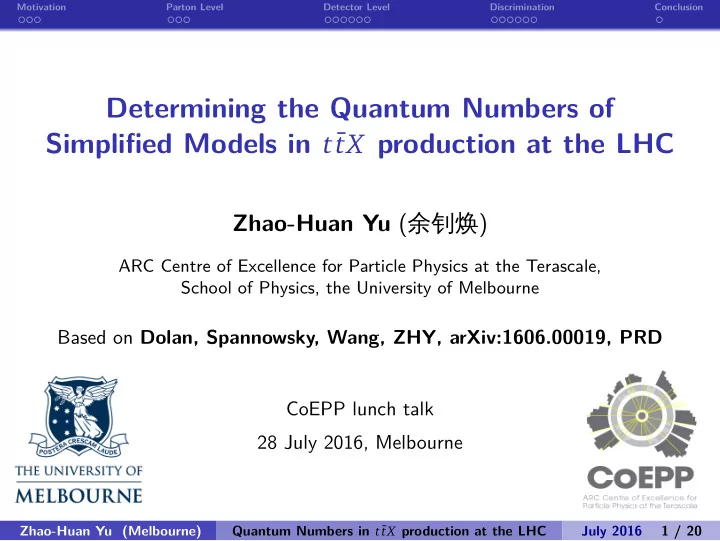
Determining the Quantum Numbers of Simplifjed Models in t¯

tX production at the LHC

Zhao-Huan Yu (余钊焕)

ARC Centre of Excellence for Particle Physics at the Terascale, School of Physics, the University of Melbourne

Based on Dolan, Spannowsky, Wang, ZHY, arXiv:1606.00019, PRD CoEPP lunch talk 28 July 2016, Melbourne

Zhao-Huan Yu (Melbourne) Quantum Numbers in t¯ tX production at the LHC July 2016 1 / 20

slide-2
SLIDE 2

Motivation Parton Level Detector Level Discrimination Conclusion

Motivation

20 40 60 80 100 1026 1025

MDM GeV Σ v cm3 s1

KRA, gNFW Γ 1.26

b Χmin

2 dof 1.44

  • 100

101 102 1. 0. 1. 2. 3. 4.

EΓ GeV 106 EΓ

2 ddEΓd GeV cm2 s1 sr1

MDM 37.8 GeV Σ v 2.10 1026 cm3s1

[Cirelli et al., 1407.2173]

Fermi-LAT Galactic Centre excess Galactic Centre excess of GeV difguse γ rays can be explained by dark matter (DM) annihilation into Standard Model (SM) particles DM annihilation into b¯ b provides a particularly good fjt ⇒ a light mediator X coupled to DM and the 3rd generation quarks? Such a light resonance at the LHC : forbidden : decay into DM forbidden is likely to dominate LHC signature

Easily hidden in Run 1 searches Promising in 13/14 TeV searches

Zhao-Huan Yu (Melbourne) Quantum Numbers in t¯ tX production at the LHC July 2016 2 / 20

slide-3
SLIDE 3

Motivation Parton Level Detector Level Discrimination Conclusion

Motivation

20 40 60 80 100 1026 1025

MDM GeV Σ v cm3 s1

KRA, gNFW Γ 1.26

b Χmin

2 dof 1.44

  • 100

101 102 1. 0. 1. 2. 3. 4.

EΓ GeV 106 EΓ

2 ddEΓd GeV cm2 s1 sr1

MDM 37.8 GeV Σ v 2.10 1026 cm3s1

[Cirelli et al., 1407.2173]

Fermi-LAT Galactic Centre excess Galactic Centre excess of GeV difguse γ rays can be explained by dark matter (DM) annihilation into Standard Model (SM) particles DM annihilation into b¯ b provides a particularly good fjt ⇒ a light mediator X coupled to DM and the 3rd generation quarks? Such a light (≲ 100 GeV) resonance X at the LHC mX < 2mt: X → t¯ t forbidden mX < 2mDM: decay into DM forbidden X → b¯ b is likely to dominate LHC signature pp → t¯ tX → t¯ t b¯ b

Easily hidden in Run 1 searches Promising in 13/14 TeV searches

Zhao-Huan Yu (Melbourne) Quantum Numbers in t¯ tX production at the LHC July 2016 2 / 20

slide-4
SLIDE 4

Motivation Parton Level Detector Level Discrimination Conclusion

Simplifjed Models

If such a new light resonance X is discovered at the LHC, the fjrst priority will be the characterisation of its spin and CP quantum numbers Four simplifjed models with a new neutral resonance which is an eigenstate

  • f parity and charge conjugation are considered

X = S (J PC = 0++): LS = − ∑

q=b,t

gqmq v S ¯ qq X = A (J PC = 0−+): LP = − ∑

q=b,t

gqmq v A¯ qiγ5q X = Z′µ

V (J PC = 1−−): LV = −

q=b,t

gqZ′µ

V ¯

qγµq X = Z′µ

A (J PC = 1++): LAV = −

q=b,t

gqZ′µ

A ¯

qγµγ5q

The production cross section depends on and

Zhao-Huan Yu (Melbourne) Quantum Numbers in t¯ tX production at the LHC July 2016 3 / 20

slide-5
SLIDE 5

Motivation Parton Level Detector Level Discrimination Conclusion

Simplifjed Models

10-1 100 101 20 40 60 80 100 120 140 160 180 200

Inclusive cross section (pb) mX (GeV) LHC, √ s = 14 TeV, tt

−X production

t t

S , gt = 1 tt

−A, gt = 1

tt

−Z′

V, gt = 0.2

t t

Z ′

A, gt = 0.2

If such a new light resonance X is discovered at the LHC, the fjrst priority will be the characterisation of its spin and CP quantum numbers Four simplifjed models with a new neutral resonance which is an eigenstate

  • f parity and charge conjugation are considered

X = S (J PC = 0++): LS = − ∑

q=b,t

gqmq v S ¯ qq X = A (J PC = 0−+): LP = − ∑

q=b,t

gqmq v A¯ qiγ5q X = Z′µ

V (J PC = 1−−): LV = −

q=b,t

gqZ′µ

V ¯

qγµq X = Z′µ

A (J PC = 1++): LAV = −

q=b,t

gqZ′µ

A ¯

qγµγ5q

The pp → t¯ tX production cross section depends on gt and mX

Zhao-Huan Yu (Melbourne) Quantum Numbers in t¯ tX production at the LHC July 2016 3 / 20

slide-6
SLIDE 6

Motivation Parton Level Detector Level Discrimination Conclusion

Spin and Parity Discrimination

0.5 1 1.5 2 2.5 3

0.01 0.015 0.02 0.025 0.03 0.035 0.04 t t

+

t t

  • b

b t t

[fb]

ll

φ ∆ d σ d

> 200 GeV

TJ

BDRS R=1.2 P

ll

φ ∆ 1 2 3 0.5 1 1.5

t t

+

σ /

t t

  • σ

[Buckley & Gonçalves, 1407.2173, PRL]

Di-leptonic top decay channel pp → t¯ tX → bℓν + bℓν + bb The azimuthal angle between the leptons ∆ϕℓℓ encodes the spin correlation information of the top pair, which is related to the ttX coupling structure Previous studies showed that ∆ϕℓℓ is useful for discriminating S (0++) from A (0−+) Semi-leptonic top decay channel Larger backgrounds The neutrino is the only source of the missing transverse momentum Able to nearly fully reconstruct the two tops Helpful for exploring other spin and parity discriminating variables

Zhao-Huan Yu (Melbourne) Quantum Numbers in t¯ tX production at the LHC July 2016 4 / 20

slide-7
SLIDE 7

Motivation Parton Level Detector Level Discrimination Conclusion

Spin and Parity Discrimination

0.5 1 1.5 2 2.5 3

0.01 0.015 0.02 0.025 0.03 0.035 0.04 t t

+

t t

  • b

b t t

[fb]

ll

φ ∆ d σ d

> 200 GeV

TJ

BDRS R=1.2 P

ll

φ ∆ 1 2 3 0.5 1 1.5

t t

+

σ /

t t

  • σ

[Buckley & Gonçalves, 1407.2173, PRL]

Di-leptonic top decay channel pp → t¯ tX → bℓν + bℓν + bb The azimuthal angle between the leptons ∆ϕℓℓ encodes the spin correlation information of the top pair, which is related to the ttX coupling structure Previous studies showed that ∆ϕℓℓ is useful for discriminating S (0++) from A (0−+) Semi-leptonic top decay channel pp → t¯ tX → b j j + bℓν + bb Larger backgrounds The neutrino ν is the only source of the missing transverse momentum / pT ⇓ Able to nearly fully reconstruct the two tops ⇓ Helpful for exploring other spin and parity discriminating variables

Zhao-Huan Yu (Melbourne) Quantum Numbers in t¯ tX production at the LHC July 2016 4 / 20

slide-8
SLIDE 8

Motivation Parton Level Detector Level Discrimination Conclusion

Parton-Level Simulation

1/σ dσ/dpT,X (GeV-1) pT,X (GeV)

LHC, √ s = 14 TeV, tt

−X production, mX = 50 GeV

tt

−S

tt

−A

tt

−Z′

V

tt

−Z′

A

0.000 0.002 0.004 0.006 0.008 0.010 0.012 100 200 300 400 500

1/σ dσ/dmtt

− (GeV-1)

mtt

− (GeV)

LHC, √ s = 14 TeV, tt

−X production, mX = 50 GeV

tt

−S

tt

−A

tt

−Z′

V

tt

−Z′

A

0.000 0.001 0.002 0.003 0.004 0.005 0.006 300 400 500 600 700 800 900 1000

FeynRules: implementation of the simplifjed models ⇓ UFO format MadGraph: parton-level simulation samples for the 14 TeV LHC Normalised distributions of pT, X and mt¯

t for mX = 50 GeV:

similar in shape; difgerent peak positions; t¯ tS is the softest; t¯ tA is the hardest

Zhao-Huan Yu (Melbourne) Quantum Numbers in t¯ tX production at the LHC July 2016 5 / 20

slide-9
SLIDE 9

Motivation Parton Level Detector Level Discrimination Conclusion

Centre-of-Mass (CM) Frame: the θ CM

t

Variable

1/σ dσ/dθt θt

LHC, √ s = 14 TeV, tt

−X production, mX = 50 GeV

tt

−S

tt

−A

tt

−Z′

V

tt

−Z′

A

0.10 0.20 0.30 0.40 0.50 0.60 0.70 0.0 0.5 1.0 1.5 2.0 2.5 3.0

Lab frame

Boost

CM frame

Distributions of θt (the angle between t and the beamline) in the lab frame show no difgerence Boost to the CM frame : a broad plateau around Other signals: a double-peak structure

Zhao-Huan Yu (Melbourne) Quantum Numbers in t¯ tX production at the LHC July 2016 6 / 20

slide-10
SLIDE 10

Motivation Parton Level Detector Level Discrimination Conclusion

Centre-of-Mass (CM) Frame: the θ CM

t

Variable

1/σ dσ/dθt θt

LHC, √ s = 14 TeV, tt

−X production, mX = 50 GeV

tt

−S

tt

−A

tt

−Z′

V

tt

−Z′

A

0.10 0.20 0.30 0.40 0.50 0.60 0.70 0.0 0.5 1.0 1.5 2.0 2.5 3.0

Lab frame

Boost

1/σ dσ/dθt

CM

θt

CM LHC, √ s = 14 TeV, tt

−X production, mX = 50 GeV

tt

−S

tt

−A

tt

−Z′

V

tt

−Z′

A

0.00 0.05 0.10 0.15 0.20 0.25 0.30 0.35 0.40 0.45 0.50 0.0 0.5 1.0 1.5 2.0 2.5 3.0

t¯ tX CM frame

t¯ tX CM frame

Beamline

¯ t X t

θCM

t

Normal ΘCM

Distributions of θt (the angle between t and the beamline) in the lab frame show no difgerence Boost to the t¯ tX CM frame ⇒ θ CM

t

▶ t¯ tS: a broad plateau around π/2 ▶ Other signals: a double-peak structure

Zhao-Huan Yu (Melbourne) Quantum Numbers in t¯ tX production at the LHC July 2016 6 / 20

slide-11
SLIDE 11

Motivation Parton Level Detector Level Discrimination Conclusion

t¯ tX CM Frame: the ΘCM Variable

t¯ tX CM frame

Beamline

¯ t X t

θCM

t

Normal ΘCM 1/σ dσ/dΘCM ΘCM

LHC, √ s = 14 TeV, tt

−X production, mX = 50 GeV

tt

−S

tt

−A

tt

−Z′

V

tt

−Z′

A

0.0 0.1 0.2 0.3 0.4 0.5 0.6 0.7 0.8 0.9 1.0 0.0 0.5 1.0 1.5 2.0 2.5 3.0

In the CM frame, the t¯ tX system forms a plane ⇓ ΘCM: the angle between the normal vector to this plane and the beamline All the signals peak at π/2 t¯ tS has the broadest distribution

Zhao-Huan Yu (Melbourne) Quantum Numbers in t¯ tX production at the LHC July 2016 7 / 20

slide-12
SLIDE 12

Motivation Parton Level Detector Level Discrimination Conclusion

Detector-Level Simulation

Main background: t¯ t b¯ b production Minor backgrounds: t¯ t + light jets, t¯ tZ, and t¯ th production Simulation: MadGraph + PYTHIA + Delphes (ATLAS setup) Jet clustering algorithm: anti-kT with R = 0.4 For pT = 100 GeV, b-tagging effjciency ∼ 73%, misidentifjcation rate ∼ 14% for c-jets, ∼ 0.27% for other light jets Selection criteria for pp → t¯ tX → b j j + bℓνℓ + b¯ b Exactly 1 charged lepton ℓ (electron or muon) isolated from any jet with ∆R > 0.4 Exactly 4 b-tagged jets and at least 2 light jets The lepton and the jets should have pT > 25 GeV and |η| < 2.5

Zhao-Huan Yu (Melbourne) Quantum Numbers in t¯ tX production at the LHC July 2016 8 / 20

slide-13
SLIDE 13

Motivation Parton Level Detector Level Discrimination Conclusion

Reconstruction

Fraction mjj (GeV)

LHC, √ s = 14 TeV, tt

−X production, mX = 50 GeV

tt

−bb

− tt

−S

tt

−A

tt

−Z′

V

tt

−Z′

A

0.00 0.02 0.04 0.06 0.08 0.10 0.12 50 100 150 200 250 300

Fraction mt,had (GeV)

LHC, √ s = 14 TeV, tt

−X production, mX = 50 GeV

tt

−bb

− tt

−S

tt

−A

tt

−Z′

V

tt

−Z′

A

0.00 0.05 0.10 0.15 0.20 0.25 100 200 300 400 500

Reconstruct the hadronically decaying top by iterating through combinations

  • f the light jets and b-jets for minimising χ2 =

(mj j − mW)2 m2

W

+ (mt,had − mt)2 m2

t

mj j: the invariant mass of two light jets j1 and j2 mt,had: the invariant mass of j1, j2, and a b-jets b1

Zhao-Huan Yu (Melbourne) Quantum Numbers in t¯ tX production at the LHC July 2016 9 / 20

slide-14
SLIDE 14

Motivation Parton Level Detector Level Discrimination Conclusion

Reconstruction

Fraction mt,lep (GeV)

LHC, √ s = 14 TeV, tt

−X production, mX = 50 GeV

tt

−bb

− tt

−S

tt

−A

tt

−Z′

V

tt

−Z′

A

0.00 0.02 0.04 0.06 0.08 0.10 0.12 0.14 0.16 100 200 300 400 500

Reconstruct the leptonically decaying top by iterating through the remaining b-jets for minimising χ2 = (mt,lep − mt)2 m2

t

mt,lep: the invariant mass constructed by a b-jets b2, the lepton ℓ, and the missing transverse momentum / pT : the invariant mass of the remaining

  • jets

and ; used to search for the resonance A clear peak at the signal resonance position The peak from may be useful for data-driven background estimation

Zhao-Huan Yu (Melbourne) Quantum Numbers in t¯ tX production at the LHC July 2016 10 / 20

slide-15
SLIDE 15

Motivation Parton Level Detector Level Discrimination Conclusion

Reconstruction

Fraction mt,lep (GeV)

LHC, √ s = 14 TeV, tt

−X production, mX = 50 GeV

tt

−bb

− tt

−S

tt

−A

tt

−Z′

V

tt

−Z′

A

0.00 0.02 0.04 0.06 0.08 0.10 0.12 0.14 0.16 100 200 300 400 500

1/σ dσ/dmbb (GeV-1) mbb (GeV)

LHC, √ s = 14 TeV, tt

−X production, mX = 50 GeV

tt

−bb

− tt

−Z

tt

−S

tt

−A

tt

−Z′

V

tt

−Z′

A

0.000 0.001 0.002 0.003 0.004 0.005 0.006 0.007 0.008 0.009 50 100 150 200 250 300

Reconstruct the leptonically decaying top by iterating through the remaining b-jets for minimising χ2 = (mt,lep − mt)2 m2

t

mt,lep: the invariant mass constructed by a b-jets b2, the lepton ℓ, and the missing transverse momentum / pT mbb: the invariant mass of the remaining b-jets b3 and b4; used to search for the resonance X A clear peak at the signal resonance position The Z peak from t¯ tZ may be useful for data-driven background estimation

Zhao-Huan Yu (Melbourne) Quantum Numbers in t¯ tX production at the LHC July 2016 10 / 20

slide-16
SLIDE 16

Motivation Parton Level Detector Level Discrimination Conclusion

Cut Flow

Selection cuts for further isolating the signal (for mX = 50 GeV): 60 GeV < mj j < 100 GeV 120 GeV < mt,had < 200 GeV 120 GeV < mt,lep < 220 GeV 35 GeV < mbb < 65 GeV Events per fb−1 t¯ t b¯ b t¯ tS t¯ tA t¯ tZ′

V

t¯ tZ′

A

No cut 24375 4211 428 714 2409 1 lepton 4612 744 80.0 132 444 4 b-tags 106 33.9 5.15 7.12 27.5 ≥ 2 light jets 72.9 22.1 3.51 4.86 18.7 mj j ∈ (60,100) GeV 42.0 12.6 2.05 2.82 10.9 mt,had ∈ (120,200) GeV 39.1 11.9 1.92 2.64 10.2 mt,lep ∈ (120,220) GeV 30.2 9.87 1.52 2.09 8.07 mbb ∈ (35,65) GeV 4.35 2.33 0.333 0.450 1.78 The t¯ t b¯ b background is suppressed by a factor of ∼ 5000

Zhao-Huan Yu (Melbourne) Quantum Numbers in t¯ tX production at the LHC July 2016 11 / 20

slide-17
SLIDE 17

Motivation Parton Level Detector Level Discrimination Conclusion

Sensitivity for Discovery

1/σ dσ/dmbb (GeV-1) mbb (GeV)

LHC, √ s = 14 TeV, tt

−X production, mX = 50 GeV

tt

−bb

− tt

−Z

tt

−S

tt

−A

tt

−Z′

V

tt

−Z′

A

0.000 0.002 0.004 0.006 0.008 0.010 0.012 50 100 150 200 250 300

Estimation of the expected exclusion on the signal Carry out a CLs hypothesis test based on the mbb distributions from 15 GeV to 200 GeV without applying the mbb cut Scale up the t¯ t b¯ b background by a factor of 1.2 in order to take into account the remaining backgrounds Assume a fmat 10% systematic uncertainty on the total background

Zhao-Huan Yu (Melbourne) Quantum Numbers in t¯ tX production at the LHC July 2016 12 / 20

slide-18
SLIDE 18

Motivation Parton Level Detector Level Discrimination Conclusion

Expected Exclusion Limits on the Signal Strength

σ (pp → tt

−S) ⋅ BR(S → bb

−) (pb) Integrated luminosity (fb-1) tt

−S production, mS = 50 GeV, 95% CL

± 2σ ± 1σ Expected 10-1 100 101 101 102 103 gt = 0.2 gt = 0.4 gt = 0.8

σ (pp → tt

−A) ⋅ BR(A → bb

−) (pb) Integrated luminosity (fb-1) tt

−A production, mA = 50 GeV, 95% CL

± 2σ ± 1σ Expected 10-1 100 101 101 102 103 gt = 0.5 gt = 1 gt = 2

σ (pp → tt

−Z′

V) ⋅ BR(Z′ V → bb

−) (pb) Integrated luminosity (fb-1) tt

−Z′

V production, mZ′

V = 50 GeV, 95% CL

± 2σ ± 1σ Expected 10-1 100 101 101 102 103 gt = 0.1 gt = 0.2 gt = 0.4

σ (pp → tt

−Z′

A) ⋅ BR(Z′ A → bb

−) (pb) Integrated luminosity (fb-1) tt

−Z′

A production, mZ′

A = 50 GeV, 95% CL

± 2σ ± 1σ Expected 10-1 100 101 101 102 103 gt = 0.05 gt = 0.1 gt = 0.2

Zhao-Huan Yu (Melbourne) Quantum Numbers in t¯ tX production at the LHC July 2016 13 / 20

slide-19
SLIDE 19

Motivation Parton Level Detector Level Discrimination Conclusion

Detector-Level Discriminating Variables

The 4-momenta of the hadronically decaying top, the leptonically decaying top, and the resonance X can be constructed from the identifjed jets and lepton: pt,had = pb1 + pj1 + pj2, pt,lep = pb2 + pℓ + / pT, pX = pb3 + pb4 The t¯ tX CM frame can be found by a Lorentz boost to the frame that satisfjes pt,had + pt,lep + pX = 0 These 4-momenta allow us to construct detector-level discriminating variables pT, X, mtt, θ CM

t,had, and ΘCM,

which are equivalent to the parton-level variables discussed above. Note that mtt ≡ (pt,had + pt,lep)2, and θ CM

t,had corresponds to the hadronically decaying top.

An analogous variable θ CM

t,lep can be defjned using pt,lep, but it is less powerful

than θ CM

t,had for discrimination among the simplifjed models. Zhao-Huan Yu (Melbourne) Quantum Numbers in t¯ tX production at the LHC July 2016 14 / 20

slide-20
SLIDE 20

Motivation Parton Level Detector Level Discrimination Conclusion

Parton Level vs Detector Level

Parton level

1/σ dσ/dpT,X (GeV-1) pT,X (GeV)

LHC, √ s = 14 TeV, tt

−X production, mX = 50 GeV

tt

−S

tt

−A

tt

−Z′

V

tt

−Z′

A

0.000 0.002 0.004 0.006 0.008 0.010 0.012 100 200 300 400 500

1/σ dσ/dpT,X (GeV-1) pT,X (GeV)

LHC, √ s = 14 TeV, tt

−X production, mX = 50 GeV

tt

−bb

− tt

−S

tt

−A

tt

−Z′

V

tt

−Z′

A

0.000 0.001 0.002 0.003 0.004 0.005 0.006 0.007 0.008 50 100 150 200 250 300 350 400

Detector level

1/σ dσ/dmtt

− (GeV-1)

mtt

− (GeV)

LHC, √ s = 14 TeV, tt

−X production, mX = 50 GeV

tt

−S

tt

−A

tt

−Z′

V

tt

−Z′

A

0.000 0.001 0.002 0.003 0.004 0.005 0.006 300 400 500 600 700 800 900 1000

1/σ dσ/dmtt (GeV-1) mtt (GeV)

LHC, √ s = 14 TeV, tt

−X production, mX = 50 GeV

tt

−bb

− tt

−S

tt

−A

tt

−Z′

V

tt

−Z′

A

0.000 0.001 0.002 0.003 0.004 0.005 0.006 200 300 400 500 600 700 800 900 1000

Zhao-Huan Yu (Melbourne) Quantum Numbers in t¯ tX production at the LHC July 2016 15 / 20

slide-21
SLIDE 21

Motivation Parton Level Detector Level Discrimination Conclusion

Parton Level vs Detector Level

Parton level

1/σ dσ/dθt

CM

θt

CM LHC, √ s = 14 TeV, tt

−X production, mX = 50 GeV

tt

−S

tt

−A

tt

−Z′

V

tt

−Z′

A

0.00 0.05 0.10 0.15 0.20 0.25 0.30 0.35 0.40 0.45 0.50 0.0 0.5 1.0 1.5 2.0 2.5 3.0

1/σ dσ/dθt,had

CM

θt,had

CM LHC, √ s = 14 TeV, tt

−X production, mX = 50 GeV

tt

−bb

− tt

−S

tt

−A

tt

−Z′

V

tt

−Z′

A

0.05 0.10 0.15 0.20 0.25 0.30 0.35 0.40 0.45 0.5 1 1.5 2 2.5 3

Detector level

1/σ dσ/dΘCM ΘCM

LHC, √ s = 14 TeV, tt

−X production, mX = 50 GeV

tt

−S

tt

−A

tt

−Z′

V

tt

−Z′

A

0.0 0.1 0.2 0.3 0.4 0.5 0.6 0.7 0.8 0.9 1.0 0.0 0.5 1.0 1.5 2.0 2.5 3.0

1/σ dσ/dΘCM ΘCM

LHC, √ s = 14 TeV, tt

−X production, mX = 50 GeV

tt

−bb

− tt

−S

tt

−A

tt

−Z′

V

tt

−Z′

A

0.0 0.1 0.2 0.3 0.4 0.5 0.6 0.7 0.5 1 1.5 2 2.5 3

Zhao-Huan Yu (Melbourne) Quantum Numbers in t¯ tX production at the LHC July 2016 16 / 20

slide-22
SLIDE 22

Motivation Parton Level Detector Level Discrimination Conclusion

CLs Hypothesis Test for Discrimination

CLs hypothesis test: study the discriminating power of each variable Analogous to those in the CMS [1411.3441] and ATLAS [1506.05669] analyses for determining the spin and parity of the SM Higgs, the test statistic is defjned as Q = −2ln L(s2 + b) L(s1 + b) L(s + b): the likelihood for the background b plus a signal hypothesis s Q: used to discriminate between signal hypotheses s1 and s2 For an observed value Qobs, the exclusion of the hypothesis s2 in favour of the hypothesis s1 (denoted as “s1 vs s2” hereafter) is evaluated in terms of the modifjed confjdence level CLs = P(Q ≥ Qobs|s2 + b) P(Q ≥ Qobs|s1 + b) P(Q ≥ Qobs|s + b): the probability for Q ≥ Qobs under a hypothesis s + b

Zhao-Huan Yu (Melbourne) Quantum Numbers in t¯ tX production at the LHC July 2016 17 / 20

slide-23
SLIDE 23

Motivation Parton Level Detector Level Discrimination Conclusion

Exclusion Limits for the Same σvis ≡ σ · BR· A· ε

σvis (fb) Integrated luminosity (fb-1) pT,X variable, 95% CL

S vs A A vs Z′

V

S vs Z′

V

10-1 100 101 102 101 102 103

Integrated luminosity (fb-1)

S vs Z′

A

A vs Z′

A

Z′

V vs Z′ A

10-1 100 101 102 101 102 103

σvis (fb) Integrated luminosity (fb-1) mtt variable, 95% CL

S vs A A vs Z′

V

S vs Z′

V

10-1 100 101 102 101 102 103

Integrated luminosity (fb-1)

S vs Z′

A

A vs Z′

A

Z′

V vs Z′ A

10-1 100 101 102 101 102 103

σvis (fb) Integrated luminosity (fb-1) θt,had

CM variable, 95% CL S vs A A vs Z′

V

S vs Z′

V

10-1 100 101 102 101 102 103

Integrated luminosity (fb-1)

S vs Z′

A

A vs Z′

A

Z′

V vs Z′ A

10-1 100 101 102 101 102 103

σvis (fb) Integrated luminosity (fb-1) ΘCM variable, 95% CL

S vs A A vs Z′

V

S vs Z′

V

10-1 100 101 102 101 102 103

Integrated luminosity (fb-1)

S vs Z′

A

A vs Z′

A

Z′

V vs Z′ A

10-1 100 101 102 101 102 103

Zhao-Huan Yu (Melbourne) Quantum Numbers in t¯ tX production at the LHC July 2016 18 / 20
slide-24
SLIDE 24

Motivation Parton Level Detector Level Discrimination Conclusion

Exclusion Limits for the Same σvis ≡ σ · BR· A· ε

σvis (fb) Integrated luminosity (fb-1) pT,X variable, 95% CL

S vs A A vs Z′

V

S vs Z′

V

10-1 100 101 102 101 102 103

Integrated luminosity (fb-1)

S vs Z′

A

A vs Z′

A

Z′

V vs Z′ A

10-1 100 101 102 101 102 103

σvis (fb) Integrated luminosity (fb-1) mtt variable, 95% CL

S vs A A vs Z′

V

S vs Z′

V

10-1 100 101 102 101 102 103

Integrated luminosity (fb-1)

S vs Z′

A

A vs Z′

A

Z′

V vs Z′ A

10-1 100 101 102 101 102 103

σvis (fb) Integrated luminosity (fb-1) θt,had

CM variable, 95% CL S vs A A vs Z′

V

S vs Z′

V

10-1 100 101 102 101 102 103

Integrated luminosity (fb-1)

S vs Z′

A

A vs Z′

A

Z′

V vs Z′ A

10-1 100 101 102 101 102 103

σvis (fb) Integrated luminosity (fb-1) ΘCM variable, 95% CL

S vs A A vs Z′

V

S vs Z′

V

10-1 100 101 102 101 102 103

Integrated luminosity (fb-1)

S vs Z′

A

A vs Z′

A

Z′

V vs Z′ A

10-1 100 101 102 101 102 103

Easy!

Zhao-Huan Yu (Melbourne) Quantum Numbers in t¯ tX production at the LHC July 2016 18 / 20

slide-25
SLIDE 25

Motivation Parton Level Detector Level Discrimination Conclusion

Exclusion Limits for the Same σvis ≡ σ · BR· A· ε

σvis (fb) Integrated luminosity (fb-1) pT,X variable, 95% CL

S vs A A vs Z′

V

S vs Z′

V

10-1 100 101 102 101 102 103

Integrated luminosity (fb-1)

S vs Z′

A

A vs Z′

A

Z′

V vs Z′ A

10-1 100 101 102 101 102 103

σvis (fb) Integrated luminosity (fb-1) mtt variable, 95% CL

S vs A A vs Z′

V

S vs Z′

V

10-1 100 101 102 101 102 103

Integrated luminosity (fb-1)

S vs Z′

A

A vs Z′

A

Z′

V vs Z′ A

10-1 100 101 102 101 102 103

σvis (fb) Integrated luminosity (fb-1) θt,had

CM variable, 95% CL S vs A A vs Z′

V

S vs Z′

V

10-1 100 101 102 101 102 103

Integrated luminosity (fb-1)

S vs Z′

A

A vs Z′

A

Z′

V vs Z′ A

10-1 100 101 102 101 102 103

σvis (fb) Integrated luminosity (fb-1) ΘCM variable, 95% CL

S vs A A vs Z′

V

S vs Z′

V

10-1 100 101 102 101 102 103

Integrated luminosity (fb-1)

S vs Z′

A

A vs Z′

A

Z′

V vs Z′ A

10-1 100 101 102 101 102 103

Hardest!

Zhao-Huan Yu (Melbourne) Quantum Numbers in t¯ tX production at the LHC July 2016 18 / 20

slide-26
SLIDE 26

Motivation Parton Level Detector Level Discrimination Conclusion

Exclusion Limits for the Same Signal Strength σ · BR

σ (pp → tt

  • X) ⋅ BR(X → bb

) (pb) Integrated luminosity (fb-1) pT,X variable, 95% CL

S vs A A vs Z′

V

S vs Z′

V

10-1 100 101 102 101 102 103

Integrated luminosity (fb-1)

S vs Z′

A

A vs Z′

A

Z′

V vs Z′ A

10-1 100 101 102 101 102 103

σ (pp → tt

  • X) ⋅ BR(X → bb

) (pb) Integrated luminosity (fb-1) mtt variable, 95% CL

S vs A A vs Z′

V

S vs Z′

V

10-1 100 101 102 101 102 103

Integrated luminosity (fb-1)

S vs Z′

A

A vs Z′

A

Z′

V vs Z′ A

10-1 100 101 102 101 102 103

σ (pp → tt

  • X) ⋅ BR(X → bb

) (pb) Integrated luminosity (fb-1) θt,had

CM variable, 95% CL S vs A A vs Z′

V

S vs Z′

V

10-1 100 101 102 101 102 103

Integrated luminosity (fb-1)

S vs Z′

A

A vs Z′

A

Z′

V vs Z′ A

10-1 100 101 102 101 102 103

σ (pp → tt

  • X) ⋅ BR(X → bb

) (pb) Integrated luminosity (fb-1) ΘCM variable, 95% CL

S vs A A vs Z′

V

S vs Z′

V

10-1 100 101 102 101 102 103

Integrated luminosity (fb-1)

S vs Z′

A

A vs Z′

A

Z′

V vs Z′ A

10-1 100 101 102 101 102 103

Zhao-Huan Yu (Melbourne) Quantum Numbers in t¯ tX production at the LHC July 2016 19 / 20

slide-27
SLIDE 27

Motivation Parton Level Detector Level Discrimination Conclusion

Conclusion

1

LHC Searches for t¯ tX production are sensitive to a new resonance X that predominantly couples to the third generation quarks. If such a resonance is discovered, a further measurement of its parity and spin will be essential for revealing the underlying new physics.

2

We demonstrated four kinematic variables for discriminating difgerent assumptions of the spin and parity in the semi-leptonic channel.

3

We found that the scalar is the easiest one to be distinguished from others, while the hardest case is to discriminate between the pseudoscalar and the axial vector.

Thanks for your attention!

Zhao-Huan Yu (Melbourne) Quantum Numbers in t¯ tX production at the LHC July 2016 20 / 20

slide-28
SLIDE 28

Motivation Parton Level Detector Level Discrimination Conclusion

Conclusion

1

LHC Searches for t¯ tX production are sensitive to a new resonance X that predominantly couples to the third generation quarks. If such a resonance is discovered, a further measurement of its parity and spin will be essential for revealing the underlying new physics.

2

We demonstrated four kinematic variables for discriminating difgerent assumptions of the spin and parity in the semi-leptonic channel.

3

We found that the scalar is the easiest one to be distinguished from others, while the hardest case is to discriminate between the pseudoscalar and the axial vector.

Thanks for your attention!

Zhao-Huan Yu (Melbourne) Quantum Numbers in t¯ tX production at the LHC July 2016 20 / 20