CSCI 446 ARTIFICIAL INTELLIGENCE EXAM 1 STUDY OUTLINE Introduction - - PDF document

csci 446 artificial intelligence exam 1 study outline
SMART_READER_LITE
LIVE PREVIEW

CSCI 446 ARTIFICIAL INTELLIGENCE EXAM 1 STUDY OUTLINE Introduction - - PDF document

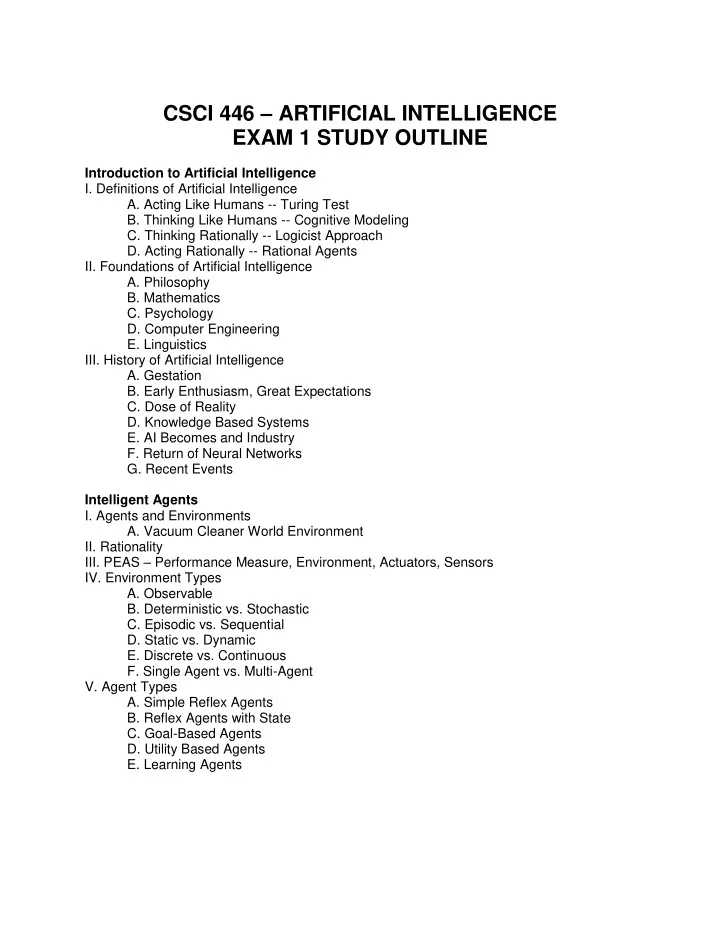
CSCI 446 ARTIFICIAL INTELLIGENCE EXAM 1 STUDY OUTLINE Introduction to Artificial Intelligence I. Definitions of Artificial Intelligence A. Acting Like Humans -- Turing Test B. Thinking Like Humans -- Cognitive Modeling C. Thinking Rationally


slide-1
SLIDE 1

CSCI 446 – ARTIFICIAL INTELLIGENCE EXAM 1 STUDY OUTLINE

Introduction to Artificial Intelligence

  • I. Definitions of Artificial Intelligence
  • A. Acting Like Humans -- Turing Test
  • B. Thinking Like Humans -- Cognitive Modeling
  • C. Thinking Rationally -- Logicist Approach
  • D. Acting Rationally -- Rational Agents
  • II. Foundations of Artificial Intelligence
  • A. Philosophy
  • B. Mathematics
  • C. Psychology
  • D. Computer Engineering
  • E. Linguistics
  • III. History of Artificial Intelligence
  • A. Gestation
  • B. Early Enthusiasm, Great Expectations
  • C. Dose of Reality
  • D. Knowledge Based Systems
  • E. AI Becomes and Industry
  • F. Return of Neural Networks
  • G. Recent Events

Intelligent Agents

  • I. Agents and Environments
  • A. Vacuum Cleaner World Environment
  • II. Rationality
  • III. PEAS – Performance Measure, Environment, Actuators, Sensors
  • IV. Environment Types
  • A. Observable
  • B. Deterministic vs. Stochastic
  • C. Episodic vs. Sequential
  • D. Static vs. Dynamic
  • E. Discrete vs. Continuous
  • F. Single Agent vs. Multi-Agent
  • V. Agent Types
  • A. Simple Reflex Agents
  • B. Reflex Agents with State
  • C. Goal-Based Agents
  • D. Utility Based Agents
  • E. Learning Agents
slide-2
SLIDE 2

State Spaces, Uninformed Search

  • I. Problem Formulation
  • A. Problem Types
  • 1. Deterministic, fully observable: Single-State Problem
  • 2. Non-observable: Conformant Problem
  • 3. Nondeterministic and/or partially observable: Contingency Problem
  • 4. Unknown state space: Exploration Problem
  • B. Single State Problem Formulation
  • 1. Initial State
  • 2. Successor Function
  • 3. Goal Test
  • 4. Path Cost
  • 5. Solution
  • II. State Space
  • III. Tree Search Algorithms
  • A. General Tree Search
  • 1. Completeness
  • 2. Time Complexity
  • 3. Space Complexity
  • 4. Optimality
  • B. Breadth First Search
  • C. Uniform Cost Search
  • D. Depth First Search
  • E. Depth Limited Search
  • F. Iterative Deepening Search
  • IV. Graph Search

Heuristic Search

  • I. Best-First Search
  • A. Heuristic Function h(n)
  • II. A* Search
  • A. Actual Cost to Current Node + Heuristic g(n) + h(n)
  • III. Heuristics
  • A. Admissible Heuristic
  • B. Consistency or Monotonicity
  • C. Dominance
  • D. Relaxed Problems

Local Search

  • I. Hill Climbing
  • A. Gradient Ascent or Descent
  • B. Local Maxima
  • C. Global Maximum
  • II. Simulated Annealing
  • III. Genetic Algorithms
slide-3
SLIDE 3

Constraint Satisfaction Problems (CSPs)

  • I. Examples
  • II. Backtracking Search
  • A. Order of Variable Assignment
  • 1. Degree Heuristic
  • B. Order of Value Assignment
  • 1. Least Constraining Value Heuristic
  • C. Early Detection of Inevitable Failure
  • 1. Forward Checking
  • 2. Arc Consistency
  • D. Problem Structure
  • III. Problem Structure and Decomposition
  • IV. Local Search for CSPs

Games (Adversarial Search)

  • I. Overview
  • II. Minimax (Perfect Play)
  • III. αβ Pruning
  • IV. Nondeterministic Games
  • A. Chance Nodes

Logical Agents

  • I. Knowledge Based Agents
  • A. Knowledge Base
  • B. Inference Engine
  • C. Separation of Knowledge and Process
  • II. An Example
  • A. Wumpus World
  • III. General Logic
  • A. Entailment
  • B. Models
  • C. Inference
  • IV. Propositional Logic
  • A. Syntax
  • B. Truth Tables
  • V. Equivalence, Validity, Satisfiability
  • VI. Inference Rules / Theorem Proving
  • A. Forward Chaining
  • B. Backward Chaining
  • C. Resolution
  • 1. Conjunctive Normal Form (CNF)
  • 2. Conversion to CNF
  • 3. Resolution
slide-4
SLIDE 4

First Order Logic

  • I. Overview
  • II. Syntax and Semantics
  • A. Basic Elements
  • B. Atomic Sentences
  • C. Complex Sentences
  • D. Models
  • E. Universal Quantification
  • F. Existential Quantification
  • III. Fun with Sentences
  • A. Equality

Inference in First Order Logic

  • I. Unification
  • A. Universal Instantiation
  • B. Existential Instantiation
  • C. Reduction to Propositional Inference
  • D. Unification
  • II. Generalized Modus Ponens
  • III. Forward and Backward Chaining
  • A. Forward Chaining
  • B. Backward Chaining
  • IV. Logic Programming
  • V. Resolution

Fuzzy Logic

  • I. Membership Functions
  • II. Linguistic Variables
  • III. Fuzzy Set Operations
  • IV. Fuzzy Inference
  • A. Fuzzification
  • B. Rule Inference
  • C. Rule Composition
  • D. Defuzzification