CSC 1800 Organization of Programming Languages Object Oriented - - PDF document

▶
csc 1800 organization of programming languages
SMART_READER_LITE
LIVE PREVIEW

CSC 1800 Organization of Programming Languages Object Oriented - - PDF document

CSC 1800 Organization of Programming Languages Object Oriented Languages 1 Introduction Many object-oriented programming (OOP) languages Some support procedural and data-oriented programming (e.g., Ada 95, C++, Python) Some


slide-1
SLIDE 1

1

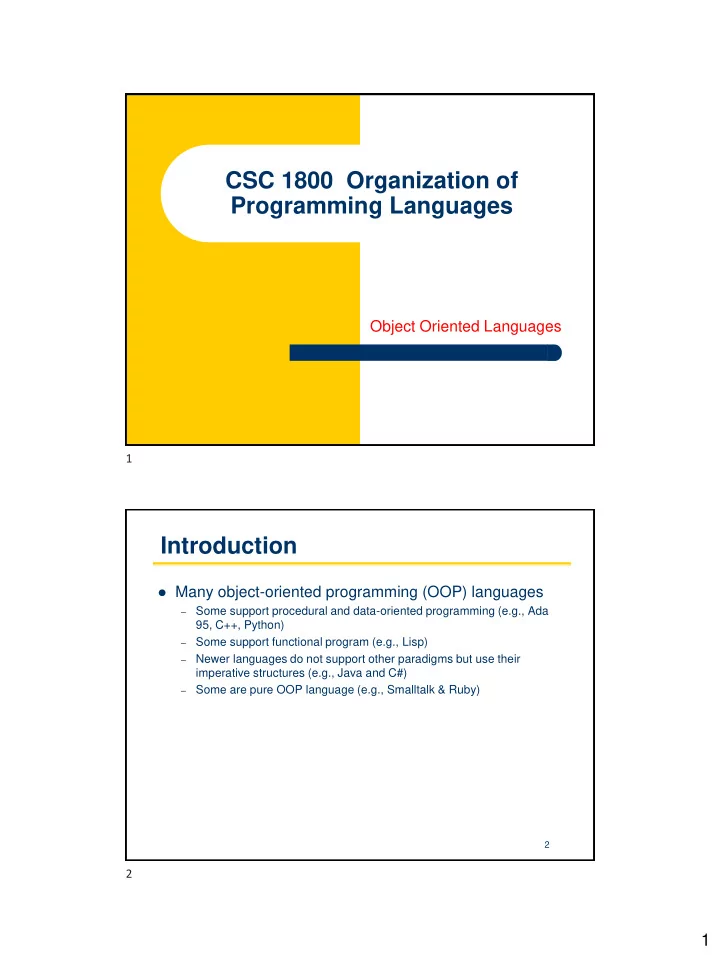
CSC 1800 Organization of Programming Languages

Object Oriented Languages

2

Introduction

⚫ Many object-oriented programming (OOP) languages

–

Some support procedural and data-oriented programming (e.g., Ada 95, C++, Python)

–

Some support functional program (e.g., Lisp)

–

Newer languages do not support other paradigms but use their imperative structures (e.g., Java and C#)

–

Some are pure OOP language (e.g., Smalltalk & Ruby)

1 2

slide-2
SLIDE 2

2

3

Object-Oriented Programming

⚫ Abstract data types ⚫ Inheritance

–

Inheritance is the central theme in OOP and languages that support it ⚫ Polymorphism

4

Inheritance

⚫ Productivity increases can come from reuse

–

ADTs are difficult to reuse—always need changes

–

All ADTs are independent and at the same level ⚫ Inheritance allows new classes defined in terms of

existing ones, i.e., by allowing them to inherit common parts

⚫ Inheritance addresses both of the above concerns--

reuse ADTs after minor changes and define classes in a hierarchy

3 4

slide-3
SLIDE 3

3

5

Object-Oriented Concepts

⚫ ADTs are usually called classes ⚫ Class instances are called objects ⚫ A class that inherits is a derived class or a subclass ⚫ The class from which another class inherits is a parent

class, base class, or superclass

⚫ Procedures that define operations on objects are called

methods

6

Object-Oriented Concepts (cont'd)

⚫ Calls to methods are called messages ⚫ The entire collection of methods of an object is called its

message protocol or message interface

⚫ Messages have two parts--a method name and the

destination object

⚫ In the simplest case, a class inherits all of the entities of

its parent

5 6

slide-4
SLIDE 4

4

7

Object-Oriented Concepts (cont'd)

⚫ Inheritance can be complicated by access controls to

encapsulated entities

–

A class can hide entities from its subclasses

–

A class can hide entities from its clients

–

A class can also hide entities for its clients while allowing its subclasses to see them ⚫ Besides inheriting methods as is, a class can modify an

inherited method

–

The new one overrides the inherited one

–

The method in the parent is overriden

8

Object-Oriented Concepts (cont'd)

⚫ There are two kinds of variables in a class:

–

Class variables - one/class

–

Instance variables - one/object ⚫ There are two kinds of methods in a class:

–

Class methods – accept messages to the class

–

Instance methods – accept messages to objects ⚫ Single vs. Multiple Inheritance ⚫ One disadvantage of inheritance for reuse:

–

Creates interdependencies among classes that complicate maintenance

7 8

slide-5
SLIDE 5

5

9

Dynamic Binding

⚫ A polymorphic variable can be defined in a class that is

able to reference (or point to) objects of the class and

  • bjects of any of its descendants

⚫ When a class hierarchy includes classes that override

methods and such methods are called through a polymorphic variable, the binding to the correct method will be dynamic

⚫ Allows software systems to be more easily extended

during both development and maintenance

10

Dynamic Binding Concepts

⚫ An abstract method is one that does not include a

definition (it only defines a protocol)

⚫ An abstract class is one that includes at least one virtual

method

⚫ An abstract class cannot be instantiated

9 10

slide-6
SLIDE 6

6

11

Design Issues for OOP Languages

⚫ The Exclusivity of Objects ⚫ Are Subclasses Subtypes? ⚫ Type Checking and Polymorphism ⚫ Single and Multiple Inheritance ⚫ Object Allocation and Deallocation ⚫ Dynamic and Static Binding ⚫ Nested Classes ⚫ Initialization of Objects

12

The Exclusivity of Objects

⚫ Everything is an object

– Advantage - elegance and purity – Disadvantage - slow operations on simple objects

⚫ Add objects to a complete typing system

– Advantage - fast operations on simple objects – Disadvantage - results in a confusing type system (two kinds of

entities)

⚫ Include an imperative-style typing system for primitives

but make everything else objects

– Advantage - fast operations on simple objects and a relatively

small typing system

– Disadvantage - still some confusion because of the two type

systems 11 12

slide-7
SLIDE 7

7

13

Are Subclasses Subtypes?

⚫ Does an “is-a” relationship hold between a parent class

  • bject and an object of the subclass?

–

If a derived class is-a parent class, then objects of the derived class must behave the same as the parent class object ⚫ A derived class is a subtype if it has an is-a relationship

with its parent class

–

Subclass can only add variables and methods and override inherited methods in “compatible” ways

14

Type Checking and Polymorphism

⚫ Polymorphism may require dynamic type checking of

parameters and the return value

–

Dynamic type checking is costly and delays error detection ⚫ If overriding methods are restricted to having the same

parameter types and return type, the checking can be static

13 14

slide-8
SLIDE 8

8

15

Single and Multiple Inheritance

⚫ Multiple inheritance allows a new class to inherit from

two or more classes

⚫ Disadvantages of multiple inheritance:

–

Language and implementation complexity (in part due to name collisions)

–

Potential inefficiency - dynamic binding costs more with multiple inheritance (but not much) ⚫ Advantage:

–

Sometimes it is quite convenient and valuable

16

Allocation and DeAllocation of Objects

⚫ From where are objects allocated?

–

If they behave line the ADTs, they can be allocated from anywhere

⚫ Allocated from the run-time stack ⚫ Explicitly create on the heap (via new)

–

If they are all heap-dynamic, references can be uniform thru a pointer

  • r reference variable

⚫ Simplifies assignment - dereferencing can be implicit

–

If objects are stack dynamic, there is a problem with regard to subtypes ⚫ Is deallocation explicit or implicit?

15 16

slide-9
SLIDE 9

9

17

Dynamic and Static Binding

⚫ Should all binding of messages to methods be

dynamic?

–

If none are, you lose the advantages of dynamic binding

–

If all are, it is inefficient ⚫ Allow the user to specify

18

Nested Classes

⚫ If a new class is needed by only one class, there is no

reason to define so it can be seen by other classes

–

Can the new class be nested inside the class that uses it?

–

In some cases, the new class is nested inside a subprogram rather than directly in another class ⚫ Other issues:

–

Which facilities of the nesting class should be visible to the nested class and vice versa

17 18

slide-10
SLIDE 10

10

19

Initialization of Objects

⚫ Are objects initialized to values when they are created?

–

Implicit or explicit initialization ⚫ How are parent class members initialized when a

subclass object is created?

20

Support for OOP in Smalltalk

⚫ Smalltalk is a pure OOP language

–

Everything is an object

–

All objects have local memory

–

All computation is through objects sending messages to objects

–

None of the appearances of imperative languages

–

All objected are allocated from the heap

–

All deallocation is implicit

19 20

slide-11
SLIDE 11

11

21

Support for OOP in Smalltalk (cont'd)

⚫ Type Checking and Polymorphism

–

All binding of messages to methods is dynamic

⚫ The process is to search the object to which the message is sent for the

method; if not found, search the superclass, etc. up to the system class which has no superclass

–

The only type checking in Smalltalk is dynamic and the only type error

  • ccurs when a message is sent to an object that has no matching

method

22

Support for OOP in Smalltalk (cont'd)

⚫ Inheritance

–

A Smalltalk subclass inherits all of the instance variables, instance methods, and class methods of its superclass

–

All subclasses are subtypes (nothing can be hidden)

–

All inheritance is implementation inheritance

–

No multiple inheritance

21 22

slide-12
SLIDE 12

12

23

Support for OOP in Smalltalk (con'd)

⚫ Evaluation of Smalltalk

–

The syntax of the language is simple and regular

–

Good example of power provided by a small language

–

Slow compared with conventional compiled imperative languages

–

Dynamic binding allows type errors to go undetected until run time

–

Introduced the graphical user interface

–

Greatest impact: advancement of OOP

24

Support for OOP in C++

⚫ General Characteristics:

–

Evolved from C and SIMULA 67

–

Among the most widely used OOP languages

–

Mixed typing system

–

Constructors and destructors

–

Elaborate access controls to class entities

23 24

slide-13
SLIDE 13

13

25

Support for OOP in C++ (cont'd)

⚫

Inheritance

–

A class need not be the subclass of any class

–

Access controls for members are

–

Private (visible only in the class and friends) (disallows subclasses from being subtypes)

–

Public (visible in subclasses and clients)

–

Protected (visible in the class and in subclasses, but not clients)

26

Support for OOP in C++ (cont'd)

⚫ In addition, the subclassing process can be declared

with access controls (private or public), which define potential changes in access by subclasses

–

Private derivation - inherited public and protected members are private in the subclasses

–

Public derivation public and protected members are also public and protected in subclasses

25 26

slide-14
SLIDE 14

14

27

Inheritance Example in C++

class base_class { private: int a; float x; protected: int b; float y; public: int c; float z; }; class subclass_1 : public base_class { … }; // In this one, b and y are protected and // c and z are public class subclass_2 : private base_class { … }; // In this one, b, y, c, and z are private, // and no derived class has access to any // member of base_class

28

Support for OOP in C++ (cont'd)

⚫ Multiple inheritance is supported

–

If there are two inherited members with the same name, they can both be referenced using the scope resolution operator

27 28

slide-15
SLIDE 15

15

29

Support for OOP in C++ (cont'd)

⚫ Dynamic Binding

–

A method can be defined to be virtual, which means that they can be called through polymorphic variables and dynamically bound to messages

–

A pure virtual function has no definition at all

–

A class that has at least one pure virtual function is an abstract class

30

Support for OOP in C++ (cont'd)

⚫ Evaluation

–

C++ provides extensive access controls (unlike Smalltalk)

–

C++ provides multiple inheritance

–

In C++, the programmer must decide at design time which methods will be statically bound and which must be dynamically bound

⚫ Static binding is faster!

–

Smalltalk type checking is dynamic (flexible, but somewhat unsafe)

–

Because of interpretation and dynamic binding, Smalltalk is ~10 times slower than C++

29 30

slide-16
SLIDE 16

16

31

Support for OOP in Java

⚫ Because of its close relationship to C++, focus is on the

differences from that language

⚫ General Characteristics

– All data are objects except the primitive types – All primitive types have wrapper classes that store one data

value

– All objects are heap-dynamic, are referenced through reference

variables, and most are allocated with new

– A finalize method is implicitly called when the garbage

collector is about to reclaim the storage occupied by the object

32

Support for OOP in Java (cont'd)

⚫ Inheritance

–

Single inheritance supported only, but there is an abstract class category that provides some of the benefits of multiple inheritance (interface)

–

An interface can include only method declarations and named constants, e.g., public interface Comparable <T> { public int comparedTo (T b); }

–

Methods can be final (cannot be overriden)

31 32

slide-17
SLIDE 17

17

33

Support for OOP in Java (cont'd)

⚫ Dynamic Binding

–

In Java, all messages are dynamically bound to methods, unless the method is final (i.e., it cannot be overriden, therefore dynamic binding serves no purpose)

–

Static binding is also used if the methods is static or private both

  • f which disallow overriding

34

Support for OOP in Java (cont'd)

⚫ Several varieties of nested classes ⚫ All are hidden from all classes in their package, except

for the nesting class

⚫ Nonstatic classes nested directly are called innerclasses

– An innerclass can access members of its nesting class – A static nested class cannot access members of its nesting

class

⚫ Nested classes can be anonymous ⚫ A local nested class is defined in a method of its nesting

class

– No access specifier is used

33 34

slide-18
SLIDE 18

18

35

Support for OOP in Java (cont'd)

⚫ Evaluation

–

Design decisions to support OOP are similar to C++

–

No support for procedural programming

–

No parentless classes

–

Dynamic binding is used as “normal” way to bind method calls to method definitions

–

Uses interfaces to provide a simple form of support for multiple inheritance

36

Support for OOP in C#

⚫ General characteristics

–

Support for OOP similar to Java

–

Includes both classes and structs

–

Classes are similar to Java’s classes

–

structs are less powerful stack-dynamic constructs (e.g., no inheritance)

35 36

slide-19
SLIDE 19

19

37

Support for OOP in C# (cont'd)

⚫ Inheritance

–

Uses the syntax of C++ for defining classes

–

A method inherited from parent class can be replaced in the derived class by marking its definition with new

–

The parent class version can still be called explicitly with the prefix base:

base.Draw() 38

Support for OOP in C#

⚫ Dynamic binding

–

To allow dynamic binding of method calls to methods:

⚫ The base class method is marked virtual ⚫ The corresponding methods in derived classes are marked override

–

Abstract methods are marked abstract and must be implemented in all subclasses

–

All C# classes are ultimately derived from a single root class, Object

37 38

slide-20
SLIDE 20

20

39

Support for OOP in C# (cont'd)

⚫ Nested Classes

–

A C# class that is directly nested in a nesting class behaves like a Java static nested class

–

C# does not support nested classes that behave like the non-static classes of Java

40

Support for OOP in C#

⚫ Evaluation

–

C# is the most recently designed C-based OO language

–

The differences between C#’s and Java’s support for OOP are relatively minor

39 40

slide-21
SLIDE 21

21

41

Support for OOP in Ada 95

⚫ General Characteristics

–

OOP was one of the most important extensions to Ada 83

–

Encapsulation container is a package that defines a tagged type

–

A tagged type is one in which every object includes a tag to indicate during execution its type (the tags are internal)

–

Tagged types can be either private types or records

–

No constructors or destructors are implicitly called

42

Support for OOP in Ada 95 (cont'd)

⚫ Inheritance

–

Subclasses can be derived from tagged types

–

New entities are added to the inherited entities by placing them in a record definition

–

All subclasses are subtypes

–

No support for multiple inheritance

⚫ A comparable effect can be achieved using generic classes

41 42

slide-22
SLIDE 22

22

43

Example of a Tagged Type

Package Person_Pkg is type Person is tagged private; procedure Display(P : in out Person); private type Person is tagged record Name : String(1..30); Address : String(1..30); Age : Integer; end record; end Person_Pkg; with Person_Pkg; use Person_Pkg; package Student_Pkg is type Student is new Person with record Grade_Point_Average : Float; Grade_Level : Integer; end record; procedure Display (St: in Student); end Student_Pkg; // Note: Display is being overridden from Person_Pkg

44

Support for OOP in Ada 95 (cont'd)

⚫ Dynamic Binding

–

Dynamic binding is done using polymorphic variables called classwide types

⚫ For the tagged type Prtdon, the classwide type is Person‘ class

–

Other bindings are static

–

Any method may be dynamically bound

–

Purely abstract base types can be defined in Ada 95 by including the reserved word abstract

43 44

slide-23
SLIDE 23

23

45

Support for OOP in Ada 95 (cont'd)

⚫ Evaluation

–

Ada offers complete support for OOP

–

C++ offers better form of inheritance than Ada

–

Ada includes no initialization of objects (e.g., constructors)

–

Dynamic binding in C-based OOP languages is restricted to pointers and/or references to objects; Ada has no such restriction and is thus more orthogonal

46

Support for OOP in Ruby

⚫ General Characteristics

– Everything is an object – All computation is through message passing – Class definitions are executable, allowing secondary definitions

to add members to existing definitions

– Method definitions are also executable – All variables are type-less references to objects – Access control is different for data and methods

⚫ It is private for all data and cannot be changed ⚫ Methods can be either public, private, or

protected

⚫ Method access is checked at runtime

– Getters and setters can be defined by shortcuts

45 46

slide-24
SLIDE 24

24

47

Support for OOP in Ruby (cont'd)

⚫ Inheritance

–

Access control to inherited methods can be different than in the parent class

–

Subclasses are not necessarily subtypes

–

Mixins can be created with modules, providing a kind of multiple inheritance ⚫ Dynamic Binding

–

All variables are typeless and polymorphic ⚫ Evaluation

–

Does not support abstract classes

–

Does not fully support multiple inheritance

–

Access controls are weaker than those of other languages that support OOP

48

Summary

⚫ OO programming involves three fundamental concepts: ADTs,

inheritance, dynamic binding

⚫ Major design issues: exclusivity of objects, subclasses and

subtypes, type checking and polymorphism, single and multiple inheritance, dynamic binding, explicit and implicit de-allocation of

  • bjects, and nested classes

⚫ Smalltalk is a pure OOL ⚫ C++ has two distinct type system (hybrid) ⚫ Java is not a hybrid language like C++; it supports only OO

programming

⚫ C# is based on C++ and Java ⚫ Ruby is a new pure OOP language; provides some new ideas in

support for OOP

⚫ JavaScript is not an OOP language but provides interesting

variations

⚫ Implementing OOP involves some new data structures

47 48