Choosing Wisely ABIM Foundation initiative Goal to encourage - - PowerPoint PPT Presentation

choosing wisely
SMART_READER_LITE
LIVE PREVIEW

Choosing Wisely ABIM Foundation initiative Goal to encourage - - PowerPoint PPT Presentation

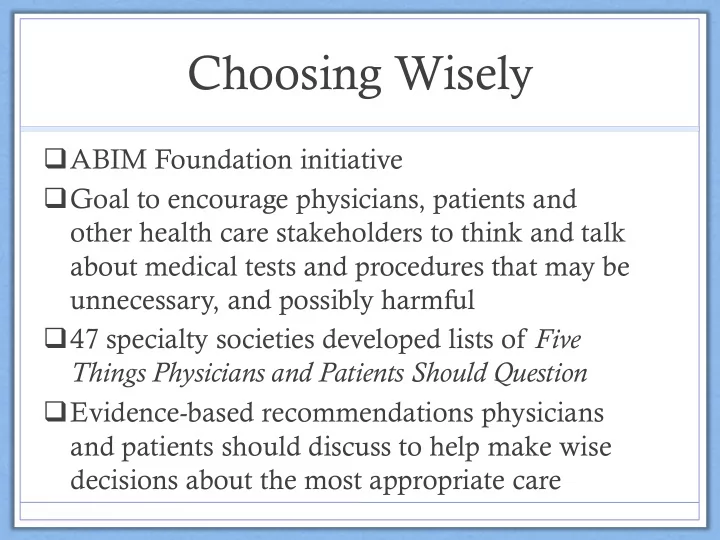
Choosing Wisely ABIM Foundation initiative Goal to encourage physicians, patients and other health care stakeholders to think and talk about medical tests and procedures that may be unnecessary, and possibly harmful 47 specialty

slide-1
SLIDE 1

Choosing Wisely

ABIM Foundation initiative Goal to encourage physicians, patients and

  • ther health care stakeholders to think and talk

about medical tests and procedures that may be unnecessary, and possibly harmful 47 specialty societies developed lists of Five Things Physicians and Patients Should Question Evidence-based recommendations physicians and patients should discuss to help make wise decisions about the most appropriate care

slide-2
SLIDE 2
slide-3
SLIDE 3

How the list was created

 Ad hoc committee from existing Clinical Practice Committee and Evidence-Based Medicine Task Force  Group developed topics that met goals of the Choosing Wisely campaign

Primary care and hospital medicine

 Reviewed evidence and chose final topics by committee vote

  • Strength of evidence
  • Committee’s unique ability to address the topic
  • Contributions to patient safety, quality and economic impact

 2 members developed topic then reviewed by entire committee  Final recommendations approved by SGIM Council

slide-4
SLIDE 4

Recommendation

In contrast to office visits for acute illness, specific evidence-based preventive strategies, or chronic care management such as treatment of high blood pressure, regularly scheduled general health checks without a specific cause including the “health maintenance” annual visit, have not shown to be effective in reducing morbidity, mortality or hospitalization, while creating a potential for harm from unnecessary testing.

slide-5
SLIDE 5

Study Measures of bias

  • Nine randomized trials totaling > 150,000 participants
  • Most trials had concealed allocation, limited selection bias, and

good follow-up

  • Bmj. 2012;345:e7191
slide-6
SLIDE 6

No effect on all-cause mortality, cardiovascular mortality, cancer mortality, or all-cause hospitalization

  • Bmj. 2012;345:e7191.
slide-7
SLIDE 7

 Most optimistic review  23 observational studies and 10 RCTs  17 Outcomes  No effect on mortality, disability and hospitalizations  Inconsistent findings on preventative care process measures (screening rates) and costs  Decreased patient worry

Annals 2007;146(4):289-300

  • L. Ebony Boulware et al.
slide-8
SLIDE 8

 Benefit in some process measures: rate of Pap test, FOBT, and patient worry  ‘Mixed’ on other process measures: Counseling, immunizations, mammography  ‘Mixed’ effect on proximate outcomes: BP, cholesterol, disease detection, health habits, BMI

Annals 2007;146(4):289-300

  • L. Ebony Boulware et al.
slide-9
SLIDE 9

Potential Harms

To patients

  • Lost time
  • Expense
  • Cascade overuse

To the system

  • Expense
  • Decrease access for
  • ther patients
slide-10
SLIDE 10

Recommendation is

 An opportunity to re-think how and when we see patients for routine visits  A recognition that all care should be tailored to individual patient needs  Evidence-based, patient-centered, and good stewardship  Consistent with good primary care  Consistent with medicine’s ethical responsibility for health care

slide-11
SLIDE 11

Recommendation is not

Reason to never see patients An attack on primary care An attack on preventive care

slide-12
SLIDE 12

Opportunity for us to lead in choosing evidence-based practice